Poriyals / Kootu Varieties.

Simple Beans Poriyal.
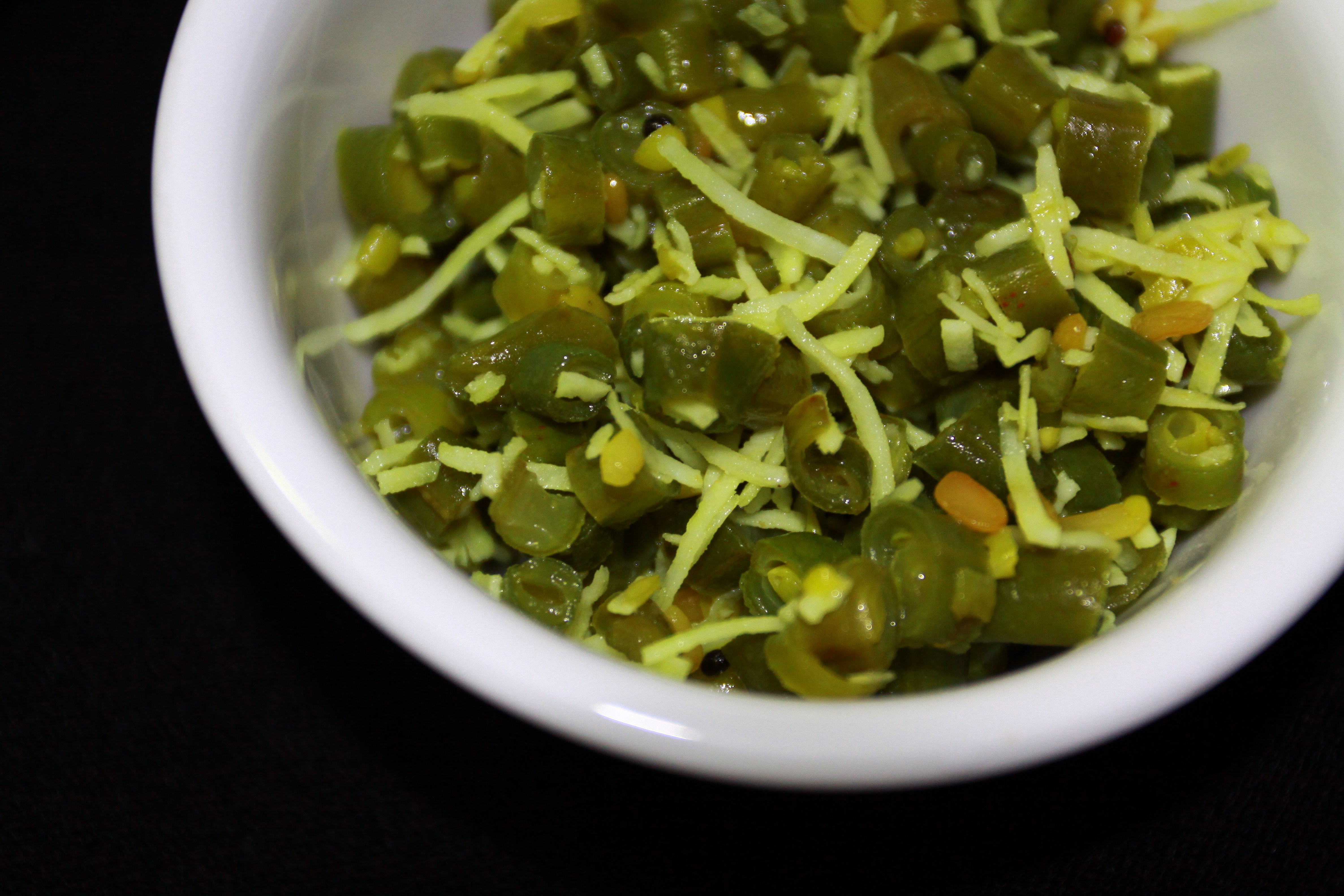
Ahhh yes, beans has always been an all time favourite. Somehow in the varying order of planning my week`s vegetables, beans would figure more than once.  A very versatile vegetables although low in calories are packed with enough nutrients . Green beans are an excellent source of vitamin C, vitamin K and manganese. Plus green beans are very good source of vitamin A (notably through their concentration of carotenoids including beta-carotene), dietary fiber, potassium, folate, and iron. And, green beans are a good source of magnesium, thiamin, riboflavin, copper, calcium, phosphorus, protein, omega-3 fatty acids and niacin.Well, that was a pretty exhaustive list courtesy the World`s Healthiest Foods Foundation.

Here is a simple Beans Poriyal simplified from the Upperi that we make sloshed with redolent coconut oil. The aroma of clean coconut oil to any cooked food is simply irresistable to me.

INGREDIENTS:

1 pound green beans cut in to small pieces.

Salt to taste.

2 spoons of dried coconut flakes.

Turmeric.

One spoon of coconut oil.  (Canola could be used instead.)

Seasoning:

Mustard, Curry Leaves, Broken Urad Dhal, Hing, 3-4 dried red chillies.

PREPARATION:

  • Take a kadai and add a spoon of coconut oil.
  • When the oil is hot, add mustard, broken urad dhal, red chillies, curry leaves then hing. When the mustard splutters, add the finely  chopped beans.
  • Add salt, turmeric and sprinkle water and allow to cook.
  • When done, simply add the 2 spoons of coconut flakes and mix well to serve.

Simple Beans Poriyal could be prepared in a jiffy to have as a side for fragrant Tomato Rasam or Yennai Kathirikkai Kozhambu.

Make sure that the beans are really fresh as this would only render it tasty and easy to cook.  Enjoy Beans Poriyal with Milagu Kuzhambu and spicy Jeera Pepper Rasam.

Kerala / Palakkad Recipes. · Naivedhyams/ Festival Offerings. · Poriyals / Kootu Varieties.

Thiruvadharai Upperi – Vegetables steamed and spiced with coconut chilli paste.

The complimenting Neivedhyam for Thiruvadharai Kali would be the Upperi or rather a version of select steamed vegetables, spiced generously with ground coconut and green chillies.  The Upperi as I remember is a combination of various tubers and roots that are combined and cooked to get the most delicious preparation. I remember as a child, when Thiruvadharai was around the corner, I knew a trip to the local crowded vegetable market at Ranganathan Street would happen pretty soon. Since the monsoons would have just finished, it would be a herculean task, just to walk in that crowded street. My friend would quip light heartedly that all one needs to do, was to stand at the beginning of Ranganathan street…the crowd would pull you to the very end!!! That said, one would hardly look forward to a weekend trip here, coming back with bagfulls of tubers and vegetables. Nevertheless, it had to be done…every year unfailingly, until, one day Madurai amma was convinced about buying it from  the vegetable man, pulling his own cart, quoting his own fancy price.

INGREDIENTS:

1/2 cup chopped Raw Banana.

1/2 cup chopped Potatoes.

1/2 cup chopped Kavathu Kazhangu.

1/2 cup Flat Bean/Avaraikka slit in to 1 inch square pieces.

1/2 cup Koorkai / Chinese Potatoes

1/2 cup Mochai / Valor Lilva.

1/2 cup Sweet Potatoes.

1/2 cup fresh coconut.

4-5 green chillies.

2 spoons of coconut oil.

Turmeric.

Seasoning:

Mustard, Curry Leaves, Hing.

PREPARATION:

  • Remove the skins from  the potatoes, raw banana, sweet potatoe, Koorkai, Kavathu , wash and chop them in to slightly big one inch pieces.
  • Arrange them in the base of a cooker vessel.
  • Next arrange the valor lilva/mochai over the root tubers.
  • Now chop the Avaraikka / flat bean over the valor lilva and add enough water for the vegetables to cook.
  • We keep the root tubers at the base as they would need to cook more.
  • Add salt and turmeric and steam in the pressure cooker for 1 whistle.
  • Remove from cooker and allow to cool.
  • Grind the coconut and green chillies to a rough paste and set aside.
  • In a kadai, add coconut oil, mustard, curry leaves and hing and slowly add all the cooked vegetables without breaking them with the spatula.
  • Mix well for a couple of minutes and then add the ground coconut paste.
  • Allow a couple minutes for the coconut mix to spread on to the vegetables.
  • Offer Thiriuvadharai Upperi to the Lord as Neivethyam.
Naivedhyams/ Festival Offerings. · Poriyals / Kootu Varieties.

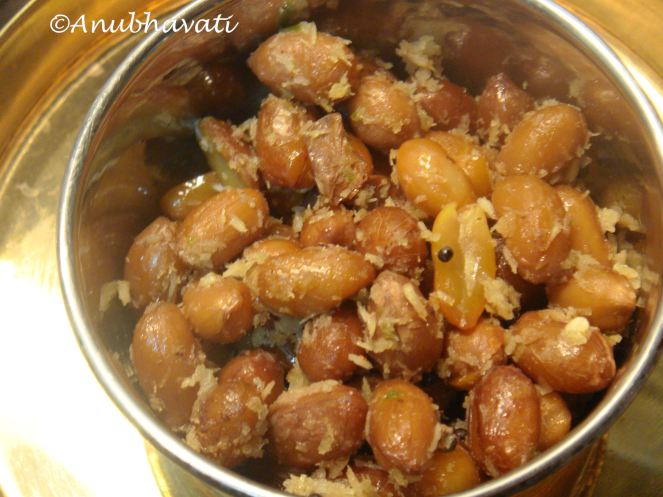
Navarathri Day 1 – Kadalai Sundal(PeanutsSpiced with coconuts and chillies) & Venn Pongal.

Today being the very first day of Navarathri and also the first saturday of the tamil month of “Purattasi”, it was an auspicious day completely. Today`s Neivedhyam was:

Venn Pongal.

Kadalai Sundal.

Kadalai Sundal.
Kadalai Sundal.

KADALAI SUNDAL:

This variety of Sundal made of raw peanuts does  not need any soaking and can be prepared with little or no notice.

INGREDIENTS:

2 cups of Raw Peanuts.

Salt

Hing

1/3 cup of fresh coconut grated.

4 Green Chillies.

Curry Leaves.

Hing

A few drops of coconut oil.

PREPARATION:

  • Place the peanuts in a cooking vessel, inside the pressure cooker and add sufficient salt. Keep enough water to just come to the level of the peanuts.
  • Cook for at least 2-3 whistles.
  • When cooled, drain all the water and save it for making sambar or rasams.
  • Take a kadai or wok and add a spoon of coconut oil.
  • When the oil is hot, add mustard, curry leaves, hing and immediately the cooked peanuts.
  • Allow to saute for a few minutes.
  • Meanwhile, pulse the coconut and green chillies without adding any water, in the mixer for a few seconds. Set aside.
  • When the contents of the kadai are well mixed and sauted, add the pulsed coconut mix.
  • Add a little more salt only if needed.
  • Offer Neivedhayam to the Goddess.
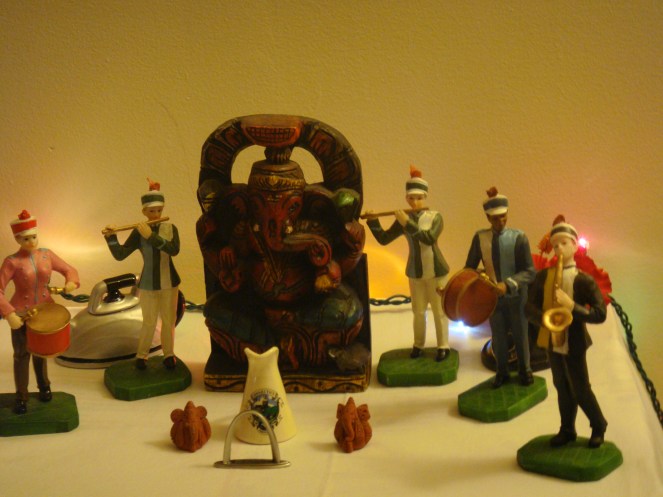
Lord Ganesha.
Lord Ganesha.

This is my entry for My Legume Love Affair – 15 going on at Sia`s Monsoon Spice, brainchild of Susan of The Well Seasoned Cook.

3877642517_283368e75d_o

Side Dishes for Rotis/Dosas/ Naan.

Aloo Dum (Baby Potatoes in Spicy Red Gravy served with lemons and onion slices).

Aloo Dum
Aloo Dum

Aloo Dum has always been a favourite of mine when we were little kids. The concept of whole baby potatoes was something very novel and so this was a dish that was always on the top of my favourites. Amma used to make Kutty Aloo Fry with the baby potatoes, which was also a delicacy to be had with steaming hot Bisi Bela Bath or Araithu vitta Vengaya Sambar.

During my short stint in Bangalore one of my friend`s mom made such awesome Aloo Dum. Her mother learnt it from the Nawabi cooks in Hyderabad in those days and aunty had carefully passed on her recipe to me.

The actual recipe calls for dry coconut but I did not have it ready in my pantry today. The recipe tastes just as great. Try it and you will realise that it is even better than the restaurant style Aloo Dum served with a lot of grease!!!

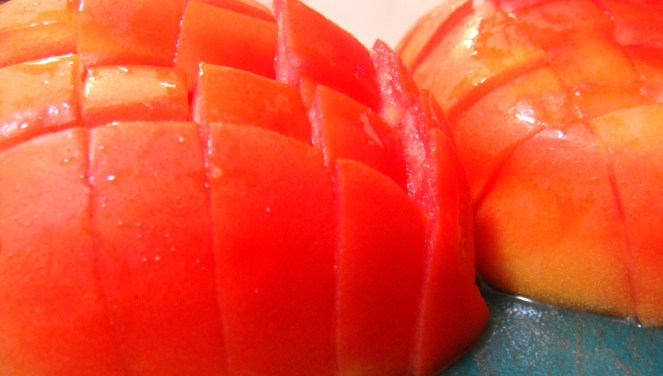
Chopped Tomatoes.
Chopped Tomatoes.

INGREDIENTS:

1 kg of Baby Potatoes.

1 Big Red Onion.

1 Big Homegrown Tomato or 2 Roma Tomatoes.

Ginger 1 inch

Garlic 3 Pods

Dry Coconut – 1 Tbsp.

Dried Kasuri Methi – 1 Tbsp.

1 tsp Garam Masala Powder.

1 tsp Red Chilli Powder.

1/2 tsp Jeera Powder.

1/2 tsp Dhania Powder.

1/4 tsp Methi Powder.

1 Tbsp Broken Cashew pieces.

Salt to taste.

Chopped Pudina

Chopped Cilantro.

3/4 – 1 cup Tamarind Water.

Cloves, Bay Leaf, Jeera  etc for seasoning.

Lemon quarters and sliced onion to serve.

PREPARATION:

  • Wash the baby potatoes in water and prick  them on both sides with a fork. This is to enable them to cook well in the salted water. Keep the skin on.
  • Cook the baby potatoes in salted water to which you can add a bay leaf and 1 or 2 cloves. Cook to one whistle only. Set aside.
  • In a kadai, add oil and saute the onions well. Set aside to cool.
  • In the same kadai, saute the chopped tomatoes and set aside to cool.
  • In the mixer grind the following: Sauted Onions, Dry coconut, Garam Masala Powder, Garlic, Ginger, Jeera Powder, Dhania Powder, Methi Powder, Cashews.
  • Make sure that they are all ground to a smooth paste nad keep aside.
  • In the kadai, add 2-3 spoons of oil, jeera a clove, bay leaf and immediately the ground paste. Saute the paste in oil until most of the raw smell is gone.
  • Now add the sauteed tomatoes, salt, turmeric powder, red chilli powder, chopped cilantro and pudina and stir well.
  • After a few more minutes, add the cooked baby potatoes and stir in well for a few more minutes.
  • Now add the tamarind water in the kadai and keeping the flame on medium low allow to cook covered.
  • The aim is to allow the aloo to get cooked in the kadai, until the oil seperates and to keep it also covered to lock in the aromas.
  • When the oil seperates, switch off the flame and serve HOT with parathas or phulkas. or simple Tiranga Pulav.
  • Restaurant style ALOO DUM is served with lemon and sliced onions.

As the oil seperates..

HINT:

This could also be made in to a dry starter entree by cutting down the tamarind water and allowing to saute until the gravy is absorbed on a slow flame. Alternately, bake it in the oven covered with foil at 400 F for 3-4 minutes. Crunchy but soft Aloo Dum Dry is ready!!!

Aloo Dum served with piping hot phulkas are packed and sent to Viki`s Kitchen for her “Side Dish for Chapathi” Event which is on until Sep 15`th 2009.

A side dish for chapathi

Side Dishes for Rotis/Dosas/ Naan.

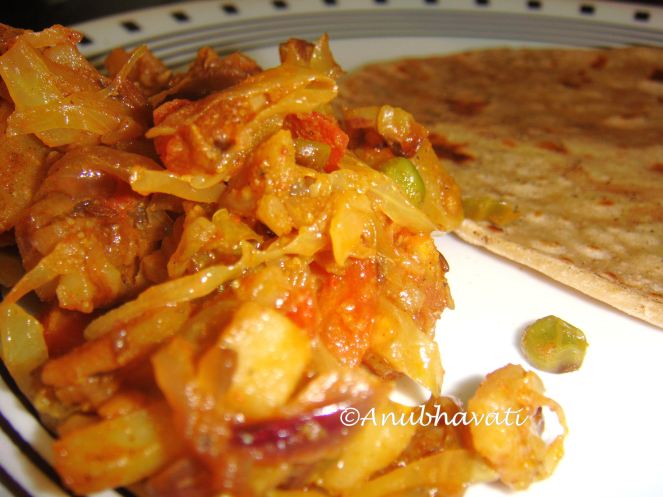
Sumptous Masala Cabbage Subzi.

Masala Cabbage Curry

One of the most misunderstood vegetables over the years  has been the Cabbage. It almost sends kids scurrying away from the dinig tables, as many children do not particularly find the smell of cooked cabbage palatable or even bearable.Cabbage is a sturdy, strong and abundant vegetable. Hardy and easy to grow, it is almost universally available in all countries and cultures. Cabbage belongs to the all important family of cruciferous vegetables. The members of this family of vegetables are so named for their cross shaped (crucifer) flower petals. Rich in nutrition and fiber, cabbage is an absolutely phenomenal source of Vitamin C. Even more impressive is that cabbage is famous for a specialized, naturally occurring, nitrogenous compound known as indoles. Current research indicates that indoles can lower the risk of various forms of cancer.

I always cook cabbage in south indian preparations like Cabbage Molagootal, Cabbage Kootu and easy Cabbage poriyal. But employing this in a subzi as a side for rotis was something that Ive always liked. This one is very tasty and delicious and completly negates the unacceptable aroma of cabbage cooking. Try it and your family would be hooked. In fact, they wouldn`t even guess that cabbage is the main ingredient.

INGREDIENTS:

1/2 a  cabbage sliced long and thin.
1 Potatoe sliced long.
2 carrots sliced long.
1 big tomato chopped in to small pieces.
A handful of peas
1 onion sliced in to thin crescents.

1 – 1 1/2 spoons of Corriander Powder.

Pinch of Garam Masala Powder.

Salt to taste.

Seasoning:

Oil

Jeera

1 tsp Ginger Garlic Paste (I make this fresh).

PREPARATION:

  • You can pre-cook the potatoes, carrots and cabbage in the microwave for 3 minutes so it saves time on the stove. Keep aside.
  • In a kadai, add 2-3 spoons of oil and for seasoning, the jeera, ginger garlic paste and allow a couple of minutes for the seasonings to saute in the oil.
  • Now add the onions and allow to saute till they are cooked.
  • Add Potatoes , Peas, carrots and cabbage to the kadai and mix in well.
  • Sprinkle enough salt, turmeric,garam masala  and the corriander powder and incorporate the flavours together.
  • After 5-6 minutes, make a small hole in the middle of the kadai and add the finely chopped tomato.
  • I guess this is done as the tomatoes do not make the subzi mushy but use the heat of the vegetables around it to slowly cook and add flavour.
  • Cover the kadai and cook on a medium low flame until the vegetables are done about 80%.
  • Cooking the vegetables completely makes the dish mushy but we need them be seperate and a little crunchy.
  • Garnish with chopped corriander and serve Hot with Parathas or rotis.
No Need of Onions!!! · Side Dishes for Rotis/Dosas/ Naan.

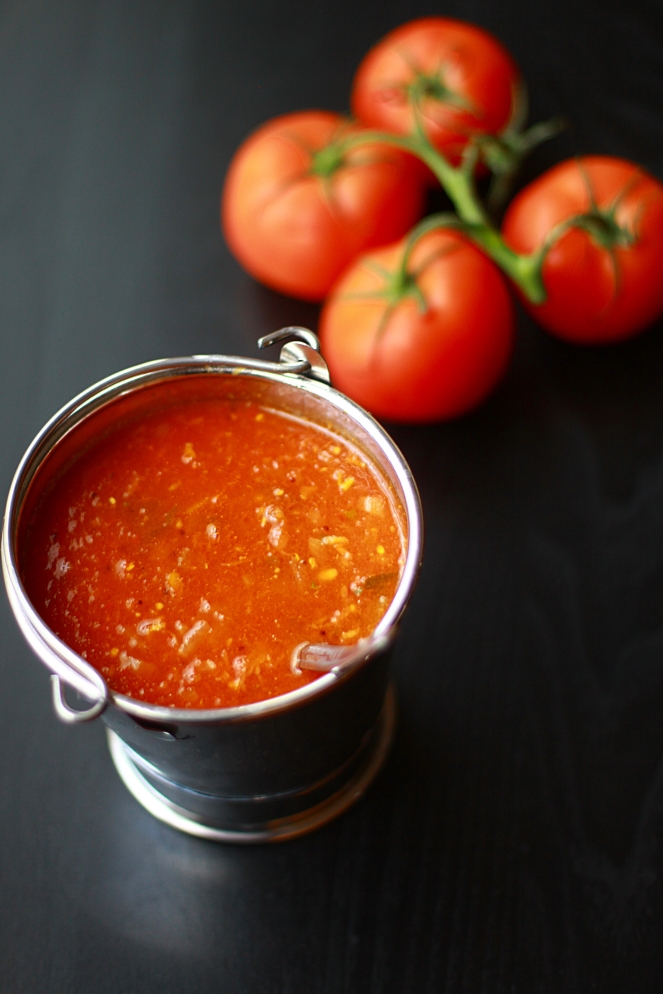
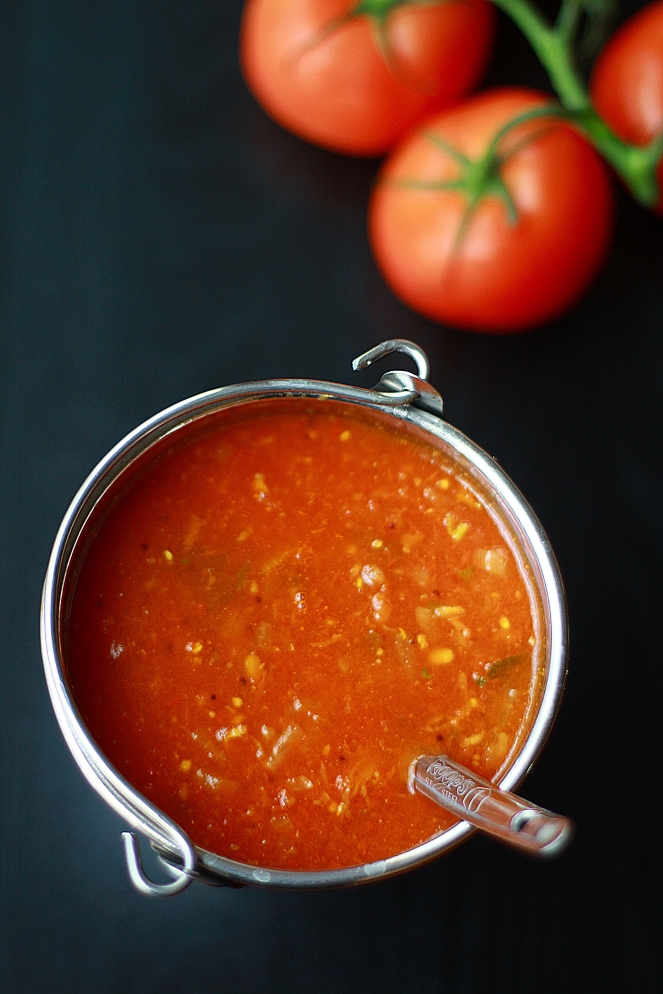
Quick N Tangy Tomato Ginger Gravy.

IMG_0499

This is a quick side dish for Venn Pongal /Vada/ Chappathi/Dosa /Puris  and Idlis. It`s pretty much easy and simple to make but vrey delicious and appetising. I remember one time when my mami made this for Pongal. We simply lapped it up!!! Yeah…its that good!!!

INGREDIENTS:

4 Big Slicing Tomatoes or Tomatoes on the Vine. Double the quantity for Roma.

1 inch Ginger finely grated.

3 Green Chillies vertically slit.

1/2 spoon Red Chilli Powder.

Salt.

Hing.

Mustard.

Turmeric.

PREPARATION:

  • Puree all the tomatoes in the mixer without adding much water and set aside.
  • In a kadai, add a spoon of oil and when hot, pop in mustard, broken urad dhal and curry leaves.
  • When the mustard splutters, add grated ginger, slit green chillies, curry leaves and a pinch of hing.
  • Allow a couple of seconds to saute and then immediately add the pureed tomato.
  • If needed, you can add 1/8 cup of water to the mixer and after a quick shake, pour it in to the kadai.
  • Add turmeric, salt and  red chilli powder and stir in well.
  • Simmer for about ten minutes and switch off heat.
  • Serve garnished with chopped cilantro.

IMG_0496

HINT:

As an option to increase the volume in case  a large serving is needed, is to saute the onions after the seasoning and then add the tomato puree. This version is made with tomatoes but it can be made without on a day when no onions need to be  consumed.

Side Dishes for Rotis/Dosas/ Naan.

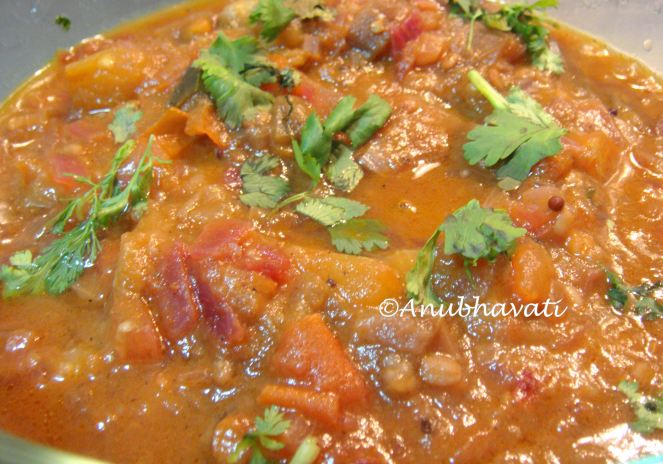
Delicious Brinjal Gothsu (Tamarind Gravy of Onions, Tomatoes and Brinjals- Side for Pongal)

Brinjal Gothsu

I guess Brinjal Gothsu was some thing I have neverhad much in my own home. There  was this one hotel in Madurai, that used to serve steaming hot blobs  of ghee laden Venn Pongal with spicy Brinjal Gothsu. TIt`s a very versatile preparation and so homes in Tamil Nadu, all have their own way of preparing the same. My mother in law also makes awesome tasty Gothsu, and she once used the base of the morning rasam for Gothsu for the night. Rehashing ingredients sometimes is more tastier than the original preparations. This combination always works as the sweet spicy tanginess in the Gothsu compensates for the peppery niceness of the Pongal. Iguess this is what my telugu friends refer to as “Gojju”. When you have guests for breakfast, Gothsu is an easy tasty side for Pongal/Dosa and Idli.

INGREDIENTS:

1 long Japanese Eggplant diced in to 1 inch cubes.

1 1/2 cups of tamarind water.

1 Onion diced in to small cubes or 15 shallots sliced in to halves.

1 Tomato chopped in to fine pieces.

1 Spoon Sambar Powder.

1 spoon of Rice Flour diluted in 4 spoons of water.

Hing

Turmeric.

Salt

Cilantro to Garnish.

Curry Leaves, Mustard & Urad Dhal for seasoning.

PREPARATION:

  • Take a kadai and place on the stove. Pour 2 spoons of oil and add urad dhal, mustard seeds and curry leaves. Keep the diced vegetbles ready to be used.
  • When the mustard splutters, add onions and allow to saute till soft. Now add the tomatoes and mix well.
  • Tap in a pinch of hing and  turmeric and cook till the tomato-onion mixture is mushy.
  • Now add the diced eggplants, sambar powder, salt and mix well.
  • Add the tamarind water and  allow around ten minutes for the brinjals also to cook in to the mixture and get soft.
  • When its a little thick, add the rice-flour water to the kadai.
  • Add some more water depending on what you want the final consistency to be.
  • Normally it would be a little thicker than “Sambar” but thinner than a chutney or dip.
  • Garnish with chopped cilantro leaves and serve hot with Venn Pongal.


Kerala / Palakkad Recipes. · No Need of Onions!!! · Poriyals / Kootu Varieties.

Vazhakkai Podimas (Raw Banana half cooked,grated, and spiced with powders)

Vazhakkai Podimas.
Vazhakkai Podimas.

Vazhakkai as in Raw Bananas already mentioned are a favourite in my family. They are readily available and when properly preserved in the refrigerator, almost stays fresh for a week or more. I never make raw bananas the day I buy them,  unless I am tempted to slice them to topple in hot oil to make fresh fresh chips spiced with salt and red chilli powder.  This time I was having a very good friend visiting and I made this for dinner. It`s a very healthy preparation as it basically cooks the raw bananas in water until they are half done, grates them and completes spicing it up on the kadai. Easy, healthy and of course quick.

INGREDIENTS:

2 Raw Bananas.

5 cups of water.

Salt.

Hing.

Turmeric,

3 spoons of boiled rice.

1  spoons of toor dhal.

1 spoon of bengal gram.

1 spoon of Dhania.

Curry Leaves.

5 Red Chillies.

PREPARATION:

  • Splice the raw banana in to two halves. without peeling the skin off. In other words, keep the skin and stalk on intact.
  • Put a container with 5-6 cups of water on the stove and allow to heat.
  • Now drop the raw banana halves in to the water and close with a lid. Allow approximately 6-7 minutes of cooking time.
  • Switch off the heat and allow a few minutes to cool.  Drain off all the water and now you will be able to easily peel the skin off.
  • The bananas should be half cooked and firm and not mushy as this will render them impossible to be grated.
  • Grate the half cooked banans and spread them on a plate. Sprinkle salt and hing and allow to settle.
  • Roast the boiled rice, toor dhal, bengal gram, red chilies and the curry leaves and grind to a coarse powder in the mixer.
  • In a kadai, add 2 spoons of oil, mustard seeds, urad dhal, curry leaves and hing and then the grated raw banana.
  • Mix well and then add the roasted ground powder. Add another 2 spoons of oil and switch off when done.
  • Serve HOT with Onion Sambar and Garlic Rasam.


No Need of Onions!!! · Poriyals / Kootu Varieties.

Crispy Arbi Fry (Colocasia part steamed and slow roasted in oil with spices)

Arbi Fry
Arbi Fry

Colocasia or Arbi or Sepangkizhangu, a starchy root tuber, very much similar to Potatoes,  has always been a favourite. It`s slightly different from the potatoes , in that it is irregular shaped and has a slightly scaly skin. When boiled, it also gives out a slightly sticky feeling so its important that the tuber is not ovber cooked. Amma would not make it too often, but when she does D and me woud devour it right away. Many of my friends at school also loved her Arbi Fry. It`s not something that I do very regularly as it does need a little extra oil,  more than I would be comfortable with…But when I do make it, I dont scrimp on the oil or the spices.

INGREDIENTS:

20 pieces or 1/2 kgs of Colocasia/Arbi/Sepangkizhangu.

Turmeric

1 1/2 spoons of Red Chilli Powder.

Salt

1 spoon of Besan and 1 spoon of Rice Flour.

Hing

A spoon of tamarind extract.

PREPARATION:

  • There are multiple varieties of this tuber available throughout the world and the one that I see in Indian and Chinese stores in the U.S are pretty bigger than their Indian counterparts.
  • Firstly wash and clean these tubers and put them, along with the skin  in to the pressure cooker. Add salt and a little tamarind water and steam for about 7-8 minutes without weight.
  • When the steamed tubers are cooled, peel away the skin and cut them in to little cross sectional rings and place them to dry on a plate. Set aside for a few minutes.
  • Sprinkle salt on the arbi rings. In a little cup mix the red chilli powder, turmeric, besan, rice flour, and hing to form a powder. Add a pinch of Sambar Powder for added spice!!
  • Sprinkle this powder on the colocasia rings and allow a few minutes for it to stick.
  • Now take a non stick kadai and add 3 spoons of oil. When hot, add mustard seeds, urad dhal, curry leaves and hing and immediately the part steamed pieces of colocasia.
  • Add some more salt or chilli  powder, if you need to at this point. Mix well and cover and cook on a low flame.
  • Add a little spoon of oil now and then so that the tubers dont burn. Keeo stirring the mixture carefully so all parts of the colocasia get cooked and also take care that they dont break.
  • In about 20-25 minutes they will be nicely done. Switch off and transfer to a serving bowl.
  • If you still want the roasted effect, spray a little oil, and pop it in to the oven at BROIL for 2 minutes alone.
  • Enjoy Delicious and crispy Sepangkizhangu/Arbi Fry with Vendekkai Sambar and Tomato Rasam.
Poriyals / Kootu Varieties.

Easy & Healthy Vazhakkai Fry.

Vazhakkai Fry
Vazhakkai Fry

The lowly vazhakkai was always a favourite vegetable for me although my mom was never such a great fan of it. I always saw how versatile this vegetable was….One could make it in to a fry, at home we always make simple “mozhukkuperatti” where its simply cooked, seasoned with mustard and curry leaves and smothered with coconut oil, use vazhakkai to make yummy “Thiruvadharai Upperi”, Vazhakkai Podimas and of course the easy Vazhakkai Chips on the slicer. I love all the forms of making this green plantain. I particularly prefer the malabar variety I guess for reason that I am used to it. I usually do not pick up the elongated variety thats available in the Indian stores.

This Vazhakkai fry is both easy and healthy as I precook it in a little water for a few minutes before actually sauteing it in the kadai to make a fry.This way, I lessen the total cooking time and also save on using a lof of oil, without compromising on taste…which I am sure you will agree once you try it too.

INGREDIENTS:

2 Green Raw Bananas or Vazhakkai.

1/2 spoon of tamarind paste (OR) i cup of diluted tamarind water.

Turmeric

Hing

1 spoon of Red Chilli Powder.

Salt as required

Oil.

PREPARATION:

  • Peel the raw bananas  and slice them vertically so they split in to two long halves. Now slice each half in to thin slices. Thin slices means easy cooking and less oil.
  • Put the chopped slices of raw bananans  in a bowl containing a cup of tamarind water. Sprinkle a little salt and place on the stove for about ten minutes till they are half cooked. The time is only an indication, and might vary according to the vessel, gas/electric stove etc. The sliced pieces need to be a little cooked yet firm.
  • Drain the water and set aside. Now take the kadai and add 2-3 spoons of oil.
  • Add mustard, urad dhal and curry leaves and when mustard splutters, add the semi cooked vazhakkai slices.
  • Add hing, salt, turmeric, red chilli powder and stir well.
  • Keep the flame on medium and constantly stir so it does not stick to the bottom and blacken.
  • When well roasted switch off and serve hot.