Kerala / Palakkad Recipes. · No Need of Onions!!! · Snacks & Tiffin Items

Sevai – (Steamed Rice Noodles made from scratch)

Delicious Home Made Sevai.

Just the name conjures up so many memories of my childhood and of my grandmother and mother toiling in the kitchen, on saturday afternoons to make delicous sevai for all of us for the evening as well as for the night.  Sevai was always thought as “labourious” as we were in a lovely joint family of 8 and cooking anything for all of us would mean laborious. But on the other side, it would be a joyous moment for me to sit and help my grandmother in the preparation and more particularly, in the partaking, which we would do all together.

My daughter had never seen me making fresh sevai as I would never attempt it when she was smaller. On  one such vacation in Madras, amma had asked me what I wanted for dinner and I promptly told her “Sevai” and we thought , “well why not? ” As we were extruding the steamed balls in the “Sevai Nazhi” or “Sevai Press”, my daughter S, who was sitting near me, doodling on a piece of paper stopped short in complete awe. She couldnt believe that some thing so beautiful could come out of the Sevai Press. She immediatly wanted to taste the freshly pressed Sevai. My mom gave her a bit, and from then on she was hooked!!!

I had tried making Sevai at home last week, sans the Sevai Press. I used the traditional ones that we normally use for making Ribbon Pakoda etc and it looks like this:
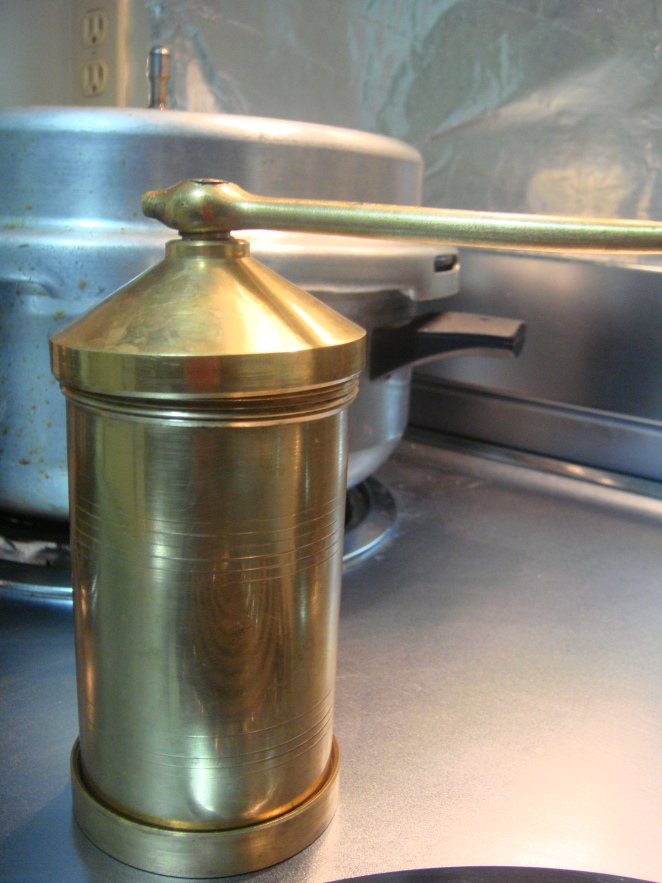
Regular Press for making Ribbon Pakoda, Mixture etc.

INGREDIENTS:

2 cups of Boiled Rice.

Salt

Pinch of Hing

A spoon of Coconut Oil.

Sevai Press or Regular Nazhi or Press.

PREPARATION:

  • Soak the boiled rice for 3 hours ahead. You could soak it even at 8 Am in the morning if you plan to make it for lunch. With the help of a grinder, grind it to a smooth paste adding enough salt . Use only as much water as is necessary.
  • Since this involves extrusion etc, it is important that the rice is ground to a smooth paste.
  • From here there are actually two methods – one which my mom in law uses and one that we have been traditionally using in my grandmother`s home. One option is to simply transfer this ground batter in to greased idli plates and steam then for 15 mins just as you would do for idlis.

(OR)

  • Transfer the contents of the grinder in to a kadai, add a pinch of hing and a spoon of coconut oil and switch on the stove on medium low flame. Keep stirring it until the water is used to cook the batter and it comes together as one. It should look like this:
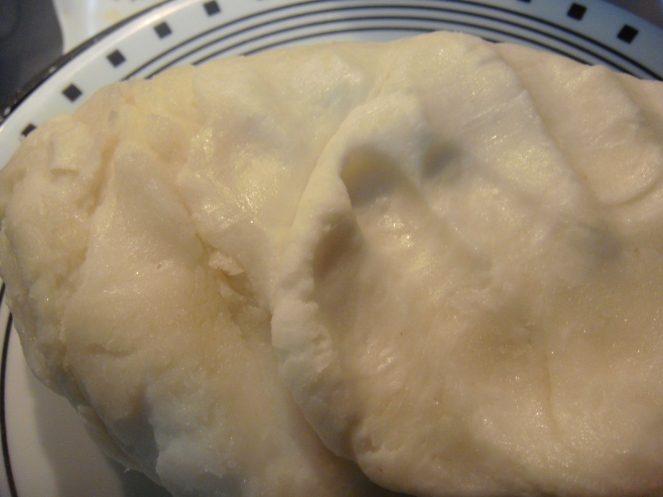
Batter cooked to make soft dough.
  • Immediately shape this dough in to rough balls and place them on  greased idli plates. Steam these balls for about ten minutes just like you would steam the idlis. This double cooking where we cook it once over the stove and once in the cooker,makes it much more easily digestible for old people and for kids alike. If you are out of time simply follow the earlier method of directly steaming the raw batter in the idli plates.
  • Once you have steamed the batter/prepared dough balls you have to start the process of sevai extrusion.
  • Briskly add the balls in to the sevai maker and press to get steaming hot noodles of rice sevai. Keep the unused balls tightly closed inside the pressure cooker as the heat is what helps in the easy pressing. Once they get cold, it would become very difficult to press.
  • As the prepared sevai is pressed on to a plate, allow to cool before adding it to a wide mouthed bowl.
  • Delicious home made Sevai is ready to be eaten plain or after seasoning as  Pulikachal Sevai. Lemon Sevai or Coconut Sevai.
Sevai.
Sevai.

TIP:

When using the regular press, to extrude the sevai, the body of the press would be very hot and so I use a kitchen mitt to hold it with my left hand and then rotate the lever with my right.

Steaming hot oodles of noodles being sent to Monthly Mingle Ravishing Rice started by Meetha.

No Need of Onions!!! · Poriyals / Kootu Varieties.

Ten Minute Healthy Cucumber Kootu.

Ten Minute Healthy Cucumber Kootu.

I guess this Kootu is built on the lines of the Kosumalli.  The only difference is that this quick preparation, the moong dal is cooked over the stove top. This quick kootu can be used as a side for any sambar or vethal kuzhambu and also as a side for rotis and phulkas. Cucumbers are a water based vegetable and hence a diuritic and  rich in vitamins. It gives a feeling of being filled and is widely used by people on diets. In my opinion, the cucumber is a versatile fruit that is tasty eaten in any form. Its used in salads, pickled in vinegar, in curries, in south indian cooking, and even as a thirst quencher.

This is an excellent recipe for people looking to cut calories as this is filling and wholesome, with no coconut, but contains cucumber, and moong dal which has lesser carbs than toor dhal or bengal gram. This is also an excellent recipe for diabetics as with parathas, it quenches the dryness and is filling.

INGREDIENTS:

2 cucumbers peeled and diced.

1/2 cup of moong dal.

Turmeric.

Salt

Hing

Cialntro to garnish.

Seasoning:

Mustard, Curry Leaves, Hing.

PREPARATION:

  • In a kadai, add a spoon of oil and when it heats, add the mustard and curry leaves and hing. Now immediately add the washed and cleaned moong dal.
  • Pour in 1/2 cup of water add salt for the moong dal and turmeric .
  • Allow the moong dal to cook in the water. If you feel that the water is used up and the moong is not yet cooked, feel free to add another 1/4 cup more.
  • When the moong dal is cooked well, simply add the chopped raw cucumber pieces.
  • Add sufficient salt and mix well to get desired consistency and switch off the heat.
  • Garnish with chopped cilantro and serve with Parathas or Vengaya Sambar or Vethal Kuzhambu.
No Need of Onions!!! · Poriyals / Kootu Varieties.

Kovakkai Curry

Kovakkai Curry
Kovakkai Curry

This was one of  my sister S`s favourite sides. She always used to like it when mami made kovakkai fry. One of the best combos for Kovakkai Fry was to have it with spicy Morkuzhambu. Kovakkai I have heard  is good for health as its rich in Vitamin A and also in fibre. Somehow my mom was never too thrilled with Kovakkai as a vegetable as its only way of cooking it is as a fry, which in itself is not very healthy. Kovakkai has to be bought fresh and the only way I know that its not too good that when cut, it has little pinkish tinges. I never keep it in the refridgerator for too long when I buy it in the stores here as the water sprayed on the vegetables in the stores is not too good for them to stay fresh.

INGREDIENTS:

1 pound of Kovakkai

1 spoon of red chilli powder.

1/2 spoon of sambar powder.

A pinch of turmeric powder.

Hing.

Seasoning:

Mustard, Broken Urad Dhal, Curry Leaves.

PREPARATION:

  • Slice the kovakkai vertically or else cut them in to cross sectional circles.
  • Allow them to dry out for a few minutes before lighting up the stove. Meanwhile sprinkle the kovakkais with the red chilli powder and hing.
  • Switch on the stove and pour 3 spoons of oil on the kadai. Allow to heat for a few minutes and then add the urad dhal and mustard seeds and when they splutter the curry leaves and hing.
  • Immediately add the chopped kovakkai and turmeric and salt.  Mix well and then add the sambar powder.
  • Sprinkle a little water to aid in cooking. Keep stirring so it doesnt catch the bottom of the kadai.
  • Add oil whenever you feel that the vegetables are cracking up on the heat.
  • Switch off when done and serve with Morkuzhambu or Vengaya Sambar.
No Need of Onions!!! · Poriyals / Kootu Varieties.

Healthy Pavakkai Fry. (Healthy BitterGourd Fry )

Healthhy Pavakkai Fry.

Bitter gourd predominantly grows in tropical areas, including parts of Asia, East Africa, the Caribbean, and South America, where it is used both as food as well as a medicine. The plant’s fruit truly lives up to its name, because it really tastes bitter. Although the seeds, leaves, and vines of this fruit have different uses, the fruit is considered as the safest and most predominantly used part of the plant.

The lowly Bitter Gourd has the following beneficial aspects:

– Helps to disinfect and heal cuts, wounds & burns

– Is useful as a cough & fever remedy

– Used in the treatment of intestinal worms and diarrhea

– Helps prevent some types of cancers

– Helps enhance the body’s immune system to ward off infections

– Serves as an effective antioxidant, antibacterial & antipyretic agent

(Courtesy –Health Benefits of  Bittergourd By Vanessa A. Doctor )

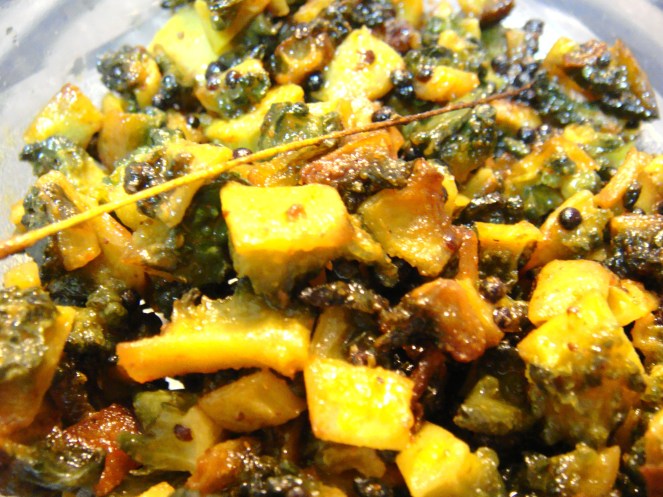
As a child, since the bittergourd was almost a bi-weekly addition to our food, I actually started liking it., I used to ask my mom to serve it along with curd rice, so I could conceal the bitterness inside the sourness of the curd. After many days, I realised that I actually started enjoying the taste. In my opinion, when cooked well, and spiced sufficiently, the bitterness ceases to be a detterant – it simple transforms to another taste just like sweet and i dont notice it anymore. I do NOT actually fry it till it turns black with a lot of oil. I simply cook it with a little oil, and some water so its more of a wholesome side.

INGREDIENTS:

3 fresh bitter gourds.

Salt

Hing

1 spoon Red Chilli Powder

Seasoning:

Mustard, Broken Urad Dhal & Curry Leaves.

PREPARATION:

  • Chop the bitter gourd in to small pieces after discarding the inner soft flesh with the seeds. Set aside on a plate.
  • In a kadai, add 2 spoons of oil and season with mustard, broken urad  dhal  and the  curry leaves.
  • Immediately add the chopped pieces of bittergourd and add salt, turmeric, hing and required red chilli powder.
  • Mix well and sprinkle a few drops of water and allow to cook over a medium low flame with stirring now and then.
  • If you feel its too dry, feel free to add another spoon of oil.
  • When well cooked switch off and serve with Venthaya Kuzhambu and appalam.


No Need of Onions!!! · Sambar / Rasam / Kuzhambu Varieties.

Venthaya Kuzhambu – (Healthy Methi and spices in tamarind gravy).

Delicious Venthaya Kuzhambu.

Venthaya Kuzhambu is a healthy quick preparation amma makes over the weekend after a month when I come home from the hostel. I would return home hungry for home cooked food and amma would pamper me with simple Venthaya Kuzhambu. Its quick, easy and utterly delicious. Since the main ingredient is only methi (fenugreek) the final taste is completely different from the regular preparations.

I remember fenugreek to be a very important ingredient for my grandfather who had blood sugar. Madurai amma would soak a poon of methi every night in water and he would drink it first thing in the morning. That helped to a large extent to keep his blood sugar at a controllable level. Fenugreek is also supposed to have anti-inflammatory properties and is also used in the treatment of reproductive disorders in women.

In this recipe you would be amazed at the flavour bursting out of a preparation with so few ingredients. ….Here it goes…

INGREDIENTS:

1 1/2 – 2 cups tamarind juice extracted.

3-4 red chillies

1 spoon of bengal gram.

1 1/2 spoons of methi seeds.

Salt according to taste.

Turmeric.

Hing.

A spoon of cooked toor dhal (Optional)

A spoon of rice flour.

Curry Leaves.

PREPARATION:

  • Dry roast the fenugreek on a medium low flame on a kadai, until you smell the aroma of the seeds. Do not allow to brown too much. Powder in the mixer to a coarse powder and set aside.
  • In a kadai, add 2-3 spoons of oil and when its hot, add bengal gram, and 3-4 red chillies and allow to roast for a couple of seconds.
  • Now add the mustard and when it splutters, add the crushed curry leaves and immediately the tamarind juice.
  • Add salt, turmeric, ground methi seeds powder, hing and allow to slowly boil on a medium low flame.
  • After about 20 minutes or so, when the gravy has been reduced, and becomes a little thick, reduce the flame.
  • Mix 1/3 cup of water in the spoon of rice flour and mix briskly to dissolve clots. Also add the spoon of cooked toor dhal to bring it to a smooth homogenous consistency.
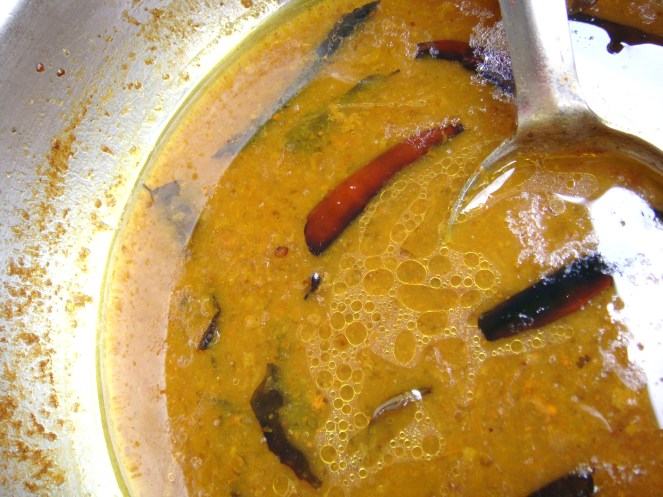
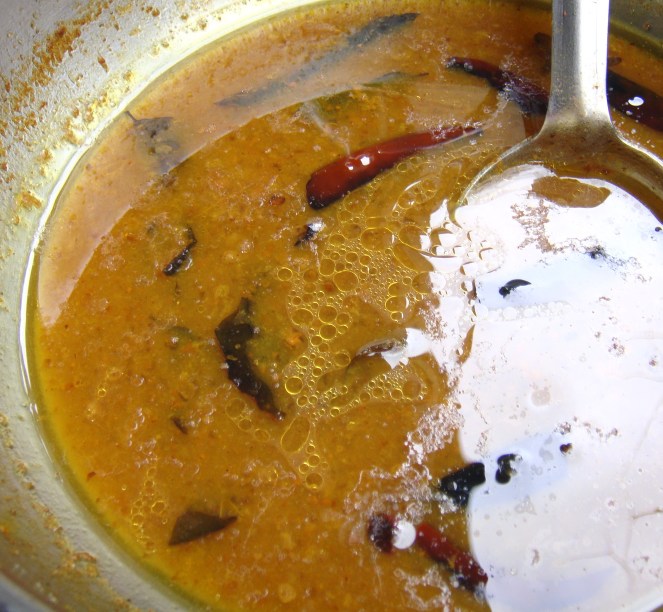
  • Pour this in to the kadai and mix well and allow to boil for a few more minutes.  (Consistency should be as shown in the pic.)
  • Delicious Venthaya Kuzhambu is ready to be served with Pavakkai Fry and Appalam.

Serving Suggestion:

Venthaya Kuzhambu is served mixed with steaming hot rice, adding 1 spoon of ghee or gingely oil to enhance the flavours of the gravy, already spiced to perfection. Best with Appalam and Alu Fry or Pavakkai Fry. I always feel it tastes best the next day as the spices have soaked in te tamarind gravy all day long!!!

dsc00954

Kid Friendly Recipes. · Naivedhyams/ Festival Offerings. · No Need of Onions!!! · Poriyals / Kootu Varieties. · Snacks & Tiffin Items

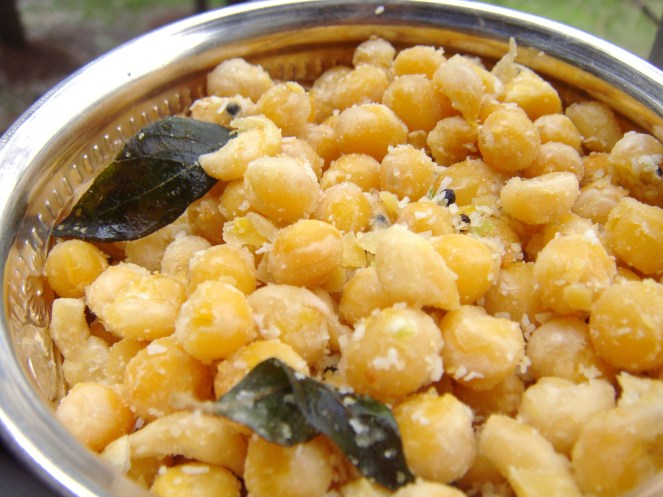
Yellow Peas Sundal. (Yellow vatana cooked and spiced with coconut and chillies)

Delicious Sundal.
Delicious Sundal.

The word sundal to me conjures up two things – One – Navarathri where “Sundals” are the main naivedhyams to the Goddess Devi and two – Marina Beach where hawkers sell the awesome Thenga Manga Pattani Sundal literally which translates to Coconut Mango and Green Peas. Although my mom has never ever allowed me to even look in to the hawker`s basket, all of us cousins secretly hoped to taste it some day as the aroma wafting in the air would be simply too much for us.

Navarathri again is an altogetherly  different option. Every day of Navarathri, we would be invited by the mamis next door and in the neighbouring apartments for “tamboolam“. So my sister and me would be dressed in our finest pattu pavadais, resplendant in their colours and happily go to their homes. Normally, we would be asked to sing a song on Devi, which we would and then after some time we would be given little baskets with turmeric, kumkum, and hot sundals wrapped in newspaper. As days went by, these newspaper parcels were stylishly replaces with little ziploc covers, but I missed those days of simplicity, where people had time to listen to little girls sing, enquire about each other in all sincerity, explain significances of the navarathri dolls etc.

Last night when I saw the little canister of yellow Peas in my pantry, I decided to soak it up overnight so I could make sundal the next day. Yellow Peas  is an excellent source of protein as its a healthy legume. Many days, its an easy snack for the kids when they come home in the evening from school as its both healthy as well as filling.

INGREDIENTS:

1 cup Yellow Peas.

1/4 cup of dessicated coconut.

3 green chillies.

Salt.

Hing.

Seasoning:

Mustard, Curry Leaves.

PREPARATION:

  • Soak the yellow peas the previous night for about 6-8 hours.  If you plan to make it for an evening snack, it is enough if you soak it that morning.
  • Drain all the water and pressure cook with a little salt and just enough water that they just reach the top of the vatana peas. Do not add too much that the peas drown in the water. This will render them mushy.
  • Switch off after 2 whistles and open after pressure is released.
  • Grind the coconut and green chillies without any water in to a coarse mix. Set aside.
  • In a kadai, add a spoon of coconut oil and when it is hot, add mustard, curry leaves and a dash of hing.
  • Immediately add the cooked yellow peas and a little salt and hing as required.
  • Garnish with the coconut-chilli mix and incorporate it well in to the peas.
  • Switch off the stove and serve with Sambar and Rice or as an evening snack for the kids – a healthy side/snack ready in minutes.

NOTE:

  • One variation is to season with only mustard and garnish with finely chopped coconut slivers, and finely chopped mango pieces. The crunchiness from the coconuts and the tang from the mangoes are incomparable.
No Need of Onions!!! · Sambar / Rasam / Kuzhambu Varieties.

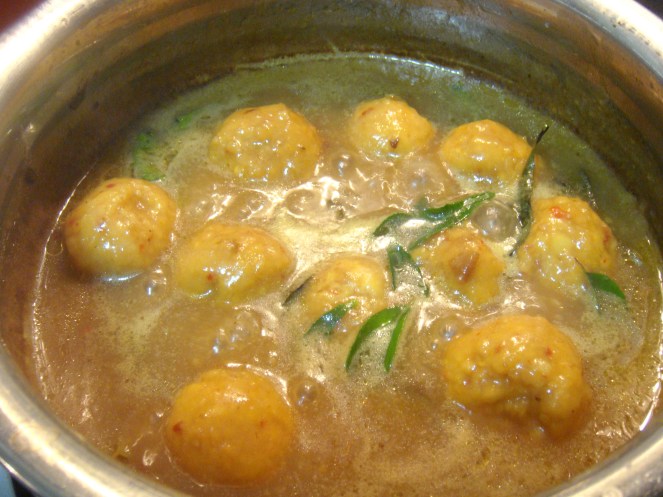
Paruppu Urundai Kuzhambu (Spiced lentil balls simmered in tamarind gravy)

Paruppu Urundai Kuzhambu

Paruppu Urundai literally means balls of lentils. These are little balls of spiced lentils which are simmered in tamarind gravy. Urundai Kuzhambu has been a delicacy reserved to certain special days like sundays or festive occassions. The balls are also an excellent accompaniment with curd rice and an enricing source of protein. Normally when amma makes Urundai Kuzhambu, there would not be any left for the evening dinner!  This was our weekend lunch menu and I wanted to share it on my blog today.

INGREDIENTS:

1/4 cup of toor dhal.

1/4 cup of bengal gram.

1-2 spoons of raw rice.

3 red chillies.

A pinh of hing

1 spoon of sambar powder.

1 spoon of rice flour.

Curry Leaves.

2 cups of tamarind extract water.

PREPARATION:

  • Soak the toor dhal, bengal gram, raw rice and red chillies in water for 1-1 1/2 hours. Then grind it with hing and a little salt to a thick  paste without adding too  much water. Try pulsing in the mixer so it helps in the easy grinding.
  • You should be able to make balls with your hands. Keep the balls of dhal aside. Add 1/4 cup of water to this mixer jar, a spoon of rice flour and give it a good shake and set this water aside.
  • In a kadai, add the 2 cups of tamarind water, sambar powder, hing, turmeric, salt, curry leaves and switch on the stove.
  • Allow the tamarind base to cook and lose all the raw smells. Now add 2 spoons of oil.(We do this so that when we drop the lentil balls in to the kuzhambu, the balls dont break.)
Lentil Balls floating...
  • Now slowly drop the prepared raw lentil balls and allow them to cook well. As these are raw lentils, you must allow sufficient time for the flavours of the tamrind and spices etc to seep in to the balls.
  • The kuzhambu will reduce and thicken slightly. When the balls are cooked pour the water from the mixer container in to the kuzhambu to bring it to a thick kuzhambu consistency.
  • Season with mustard, curry leaves and pour over the kuzhambu and serve HOT with Vendekkai Fry.
No Need of Onions!!! · Poriyals / Kootu Varieties.

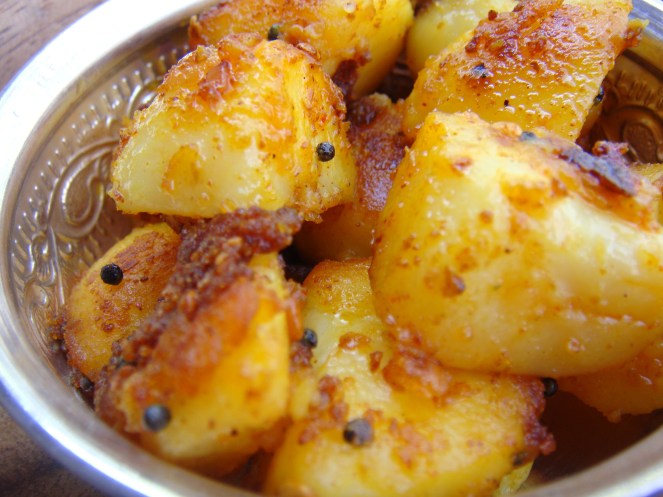
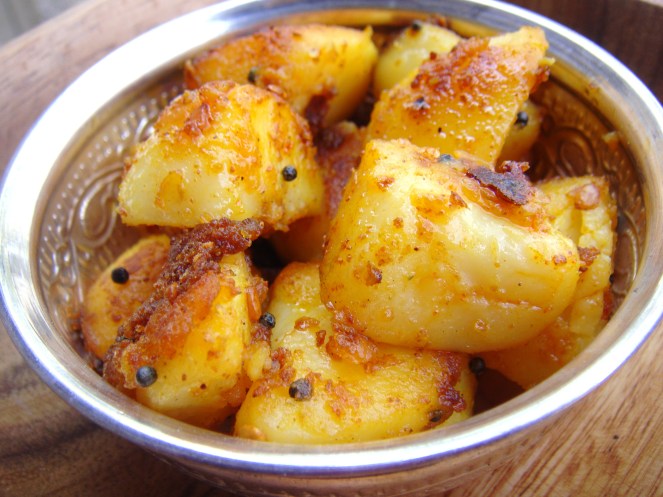
Urulai Fry (Alu Fry) – Potatoes flavoured with spices and finished in the Oven.

Urulai Fry.
Urulai Fry.

My husband got a huge bag of golden potatoes from the Indian store demandng me to make his favourite alu fry. These were the smaller golden potatoes with very thin skin which cooks pretty fast. So I got around to making it and I always start by pre-cooking it for  one whistle in the pressure cooker, lightly sauteing it in the pan and then broiling it in the oven. It`s fast, easy and very very original.

INGREDIENTS:

8-9 Medium to Small Potatoes.

Pinch of Turmeric.

Salt.

1 spoon of Red Chilli Powder.

Hing

Seasoning:

Oil, Mustard, Broken Urad Dhal and curry leaves.

PREPARATION:

  • Peel the skin off all the potatoes and drop them in a vessel with a little water and salt and cook them for JUST ONE WHISTLE in the pressure cooker. Remove the cooker from the electric plate and keep in a cool place.
  • When the water is drained and the potatoes cooled, chop them in to big 1  inch pieces and set aside.
  • In a kadai, add 3 spoons of oil and when hot, add mustard, urad dhal and the curry leaves and a pinch of hing and then immediately the pieces of potatoes.
  • Add requisite salt, turmeric, red chilli powder and stir well.
  • Cook till the salt and the spices are well flavoured on the potatoes.
  • After about ten to fifteen minutes switch off the stove.
  • Preheat the oven to 400 F and grease an oven proof dish with oil spray and pop the potatoes in it.
  • Place the potatoes inside the oven for 3-4 minutes.
  • Now turn the setting to BROIL and allow it to broil for exactly 1 1/2 minutes.
  • Take out the potatoes, give it a stir so that the potaotes below come up.
  • Broil again for exactly 1 1/2 minutes. BROILING FOR ANY MORE TIME WOULD BLACKEN THE BEAUTIFULLY DONE POTATOES.
  • Serve sizzling hot with Paruppu Urundai Kozhambu and Pumpkin Kootu.

NOTES:

The option of broiling in oven is to cut back on the oil consumed in getting the “fried” taste and texture. It can be completely cooked on the stove top, on medium flame , adding oil now and then.

dsc007771

No Need of Onions!!! · Poriyals / Kootu Varieties.

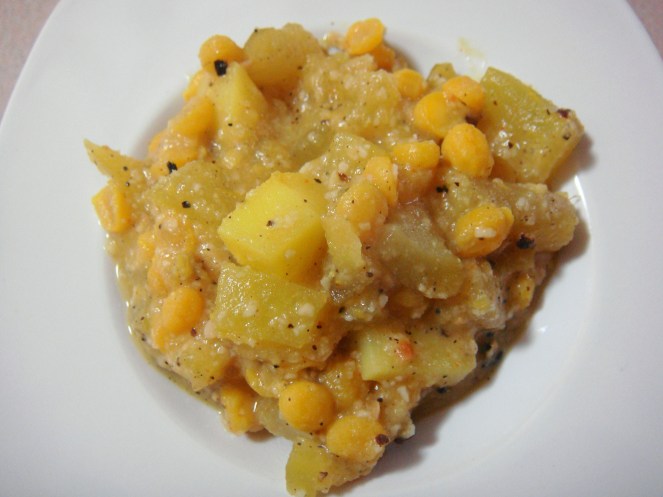
Pumpkin Potatoes & Koorkai Poricha Pepper Kootu.

Pumpkin Potatoes and Koorkai Kootu.

Sundays are always meant for lazy morning brunches and steaming hot early dinners of home made goodness. I had this lovely fresh piece of pumpkin inside my refridgerator and my husband decided he wanted a kootu – which is a side – almost a thick gravy. I had already made the Paruppu Urundai Kuzhambu from yesterday and the freshly made kootu smelling of vegetables and coconut and peppery niceness that it was a flawless compliment. I decided to toss in the koorkai at the last instant as I love the flavour and aroma of this root tuber. This preparation is pretty versatile so it could be substituted with any vegetable like chayote, bottle gourd, cucumber etc.

INGREDIENTS:

1 1/2 – 2 cups of chopped pumpkin.

2 Medium Potatoes Chopped.

A handful of chopped Koorkai.

1/4 cup of cooked bengal gram.

2 tsp of broken urad dhal.

A spoon of black pepper.

1/3 cup of dessicated  coconut.

A spoon of cooked toor dhal (optional).

A pinch of turmeric.

A pinch of red chilli powder.

Salt.

A pinch of hing.

Seasoning:

Mustard, Broken Urad Dhal, Curry Leaves.

PREPARATION:

  • Take the vessel and add all the chopped vegetables, pour just enough water so it just covers the veggies and switch on the stove. Add salt, turmeric and red chilli powder and allow them to cook well.
  • Cook the bengal gram so it does’nt get too mushy but just enough.
  • Take a small seasoning kadai and roast the urad dhal, pepper and a few curry leaves in oil till the urad dhal turns golden brown.
  • Grind this with the coconut to a smooth paste and set aside.
  • When the vegetables are cooked well, add the ground paste, cooked bengal gram, salt if necessary, a spoon of cooked toor dhal. Mix well and allow to come together.
  • Season in gingely oil with mustard, urad dhal and curry leaves and serve with Paruppu Urundai Kuzhambu and Lemon Rasam.

Weekend Menu 1:

Paruppu Urundai Kuzhambu,

Tomatillo Lemon Rasam ,

Pumpkin Potatoes & Koorkai Poricha Kootu &

Urulai Fry./Alu Fry.

No Need of Onions!!! · Sambar / Rasam / Kuzhambu Varieties.

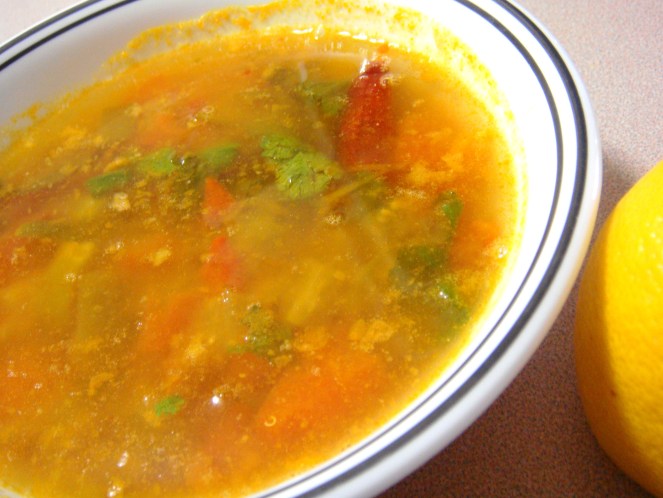
Tangy Tomatillo Lemon Rasam.

Tangy Tomatillo Lemon Rasam.

Cold weather and rains always make me remember Comfort Foods….Foods that have been a part of our growing up, something that I always took for granted for a long long time. When I went to stay in the hostel for my Masters, I realised the warmth and love that goes in to the food our moms make for us. Nothing that I can have in restaurants can even come close to the lingering fragrance and warmth from food cooked at home with loving hands.

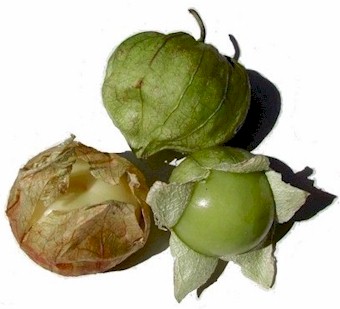
After a festival or function,we would crave for amma`s home made simple pathyam food to cleanse our systems.  I always loved her simple lemon rasam with Beans Curry or Chow Chow Kootu and Appalam. I am not so happy with the tomatoes here in the U.S, as I feel they lack tartness and tang. Yesterday when I saw tomatillos at the local produce store, I bought a pound or two, all the while imaging endless possibilities. Tomatillos can be stored in paper bags and kept in the refridgerator for around 2-3 weeks. The tomatillos have a protective outside husk. Remove the husk and wash before use. Tomatillos are used in many places in teh treatment of fever. I had to make this lemon rasam today, as its been pouring since morning and I suddenly yearned for amma`s cooking…

Tomatillos with husks...
Tomatillos with husks…Pic Courtesy Gourmetsleuth.com

INGREDIENTS:

2 Tomatillos or 1 Tomato

1  Jalapeno  slit vertically.

2 red chillies.

2 1/2  cups of water

4 spoons of cooked Toor dhal.

1 Inch Piece of Tamarind.

1 Tsp Rasam Powder

Hing

Curry Leaves.

1 Lemon.

Salt

Cilantro / Curry Leaves to Garnish.

PREPARATION:

  • Chop the tomatillos in to little pieces so it saves cooking time. Dilute the cooked toor dhal in the 2 1/2 cups of water and set aside.
  • In a kadai, add a spoon of ghee and when it is hot, add mustard. When the mustard splutters, add hing, curry leaves, red chillies, slit jalapenos, and finally the chopped tomatillos.
  • Allow to saute for a few minutes till the tomatillos are a little mushy.
  • Add 1 cup  of the dhal water at this stage and allow to simmer. Add salt, hing, Rasam powder and  turmeric.
  • After about ten  minutes, remove in a spoon, a few cooked pieces of tomatillos and crush them with a spoon in a cup. Add the remaining 1 1/2 cups of toor dhal water to the crushed tomatillos and pour it all back in to the kadai.
  • Allow the whole rasam to simmer and then switch off in about 15 minutes or so. Garnish with freshly chopped cilantro and curry leaves. Keep the rasam closed.
  • After the rasam has cooled down a bit,  squeeze the juice from the lemon and keep closed again until time to serve.
  • Serve HOT with Beans Poriyal or Pumpkin Poricha Kootu. Alu Fry is always the recommended option!!

NOTES:

  • The same rasam can be made with regular tomatoes too. I add a pinch of  tamarind to the dal water as it cooks.
  • Adjust the tartness based on the sourness of the Lemon/ lime etc.
  • For added taste,  you can zest the lemon a little bit after switching off the stove
  • Add a marble size of jaggery for added taste.

Let me know what you think! Did you try it?