Festivals & Significance

Sri Krishna Jayanthi – Significance & Offerings to the Lord.
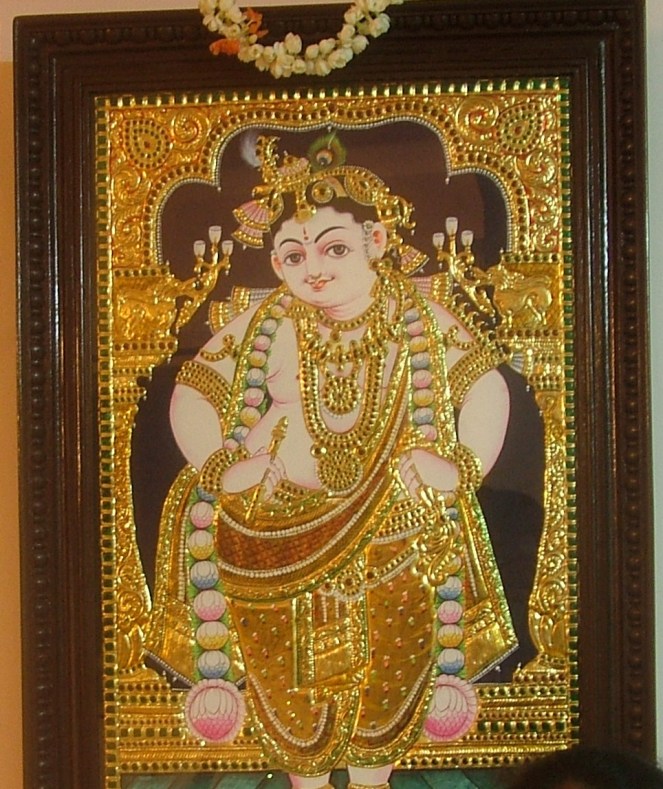
Lord Shri Krishna in a lovely Tanjore Painting at my home.

Krishna Jayanthi is celebrated as the birthday of Lord Shri Krishna. Lord Sri Krishna was born on the ‘Rohini’ nakshatram (star) on Ashtami day.  The festival Sri Krishna Jayanti is also known as Gokulashtami and Janmashtami. Sri Krishna is Lord Vishnu’s eighth avatar (incarnation) on earth. He is considered to be the Lord’s most glorious incarnations.  Even saying and remembering His name brings joy because Sri Krishna himself was a manifestation of joy at all levels and in all walks of life. In Tamil Nadu Krishna Jayanthi is celebrated with great pomp as its a festival spelling happiness and joy as the saviour was born on this day.

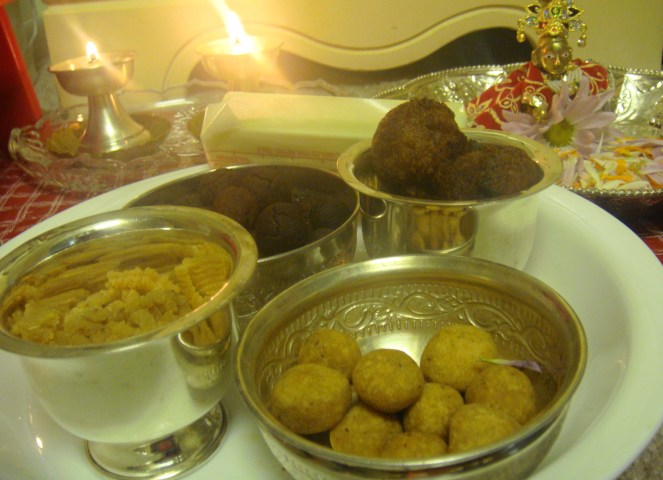
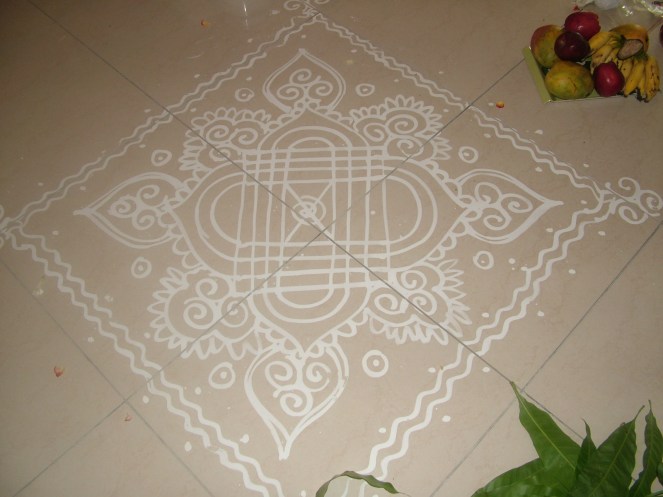
People offer sweets like Vella Cheedai, Aval or Poha Payasam, Butter etc as these happen to be the Lord`s favourites. Many homes have beautiful kolams adorning their homes and little feet drawn in the floors as if to show little Krishna coming in to our homes. Poojas are performed and flowers and neivedhyams are offered late in the evening when the moon rises as this is the time the Lord was born.
DSCF5111

In my home, Krishna Jayanthi is celebrated with the utmost devotion and love. From the time I learnt the art of “Yezha Kolams” when I was in school, it was my bounden responsibility to decorate the front yard with lovely kolams and with little baby footprints coming all the way to the pooja sanctum at home. In the mornings, we would help Madurai amma roll out the Cheedai balls and scrape the jaggery for the sweets. My sister and me would thread cleaned mango leaves in to a “Thoranam” and hang it outside our main entrance to the home. The home would be cleaned and decorated to welcome the little Lord!!!
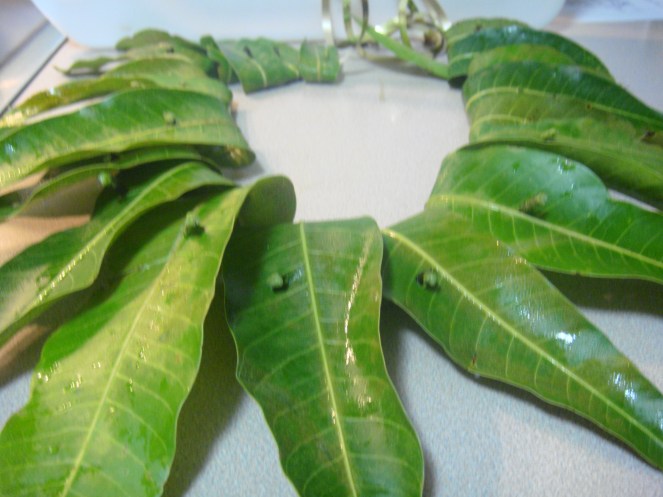
Mango Leaves threaded in to a Thoranam.

Prayers Offered:

Krishnashtakam

Sri Krishna Ashtothram

Madhurashtakam

Sri Vishnu Sahasranamam.

Maduraiamma`s Uruli with flowers.

Neivedhyams Offered to the Lord:

Gokulashtami Neivedhyams


Brisk Breakfast · No Need of Onions!!! · Snacks & Tiffin Items

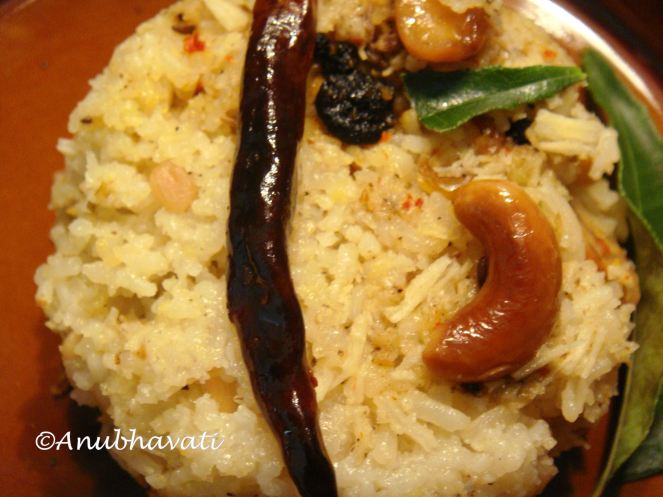
Quick Fix Arisi Upma (Upma made from coarse cream of rice cooked with seasoned spices)

Quick Fix Arisi Upma

Every evening from school meant having tiffin prepared by dear Madurai amma. It would not be a lot in quantity, just a little bit to satisfy that crazy hunger pangs when you come home from school after a tiring day and a crowded journey jostled in public transport. It would not even be warm, let alone hot, but lovingly served. When you are a student, somehow you crave for exotic eatables like Gobi Manchurian, fried rice. pulav, channa batura and the like. In contrast, madurai amma would make Upma,  Pidi Kozhakattai,  Poha, Dosa etc. After some  years, in my hostel for my Masters, I would recount those lovely home made preparations waiting for you when you come home after a tiring day. Life after masters was completely different. I started eating all fruits and vegetables and an thing that amma or Madurai amma would prepare and serve on  my plate. I had realised the importance of what I had taken for granted!!!

One such tiffin entree that Madurai amma was an expert at, was  Arisi Upma. Many times, it would be the dinner for every one on Amma Vasya, festivals, Pradosham etc.This evening, I had made Arisi Upma for dinner and was recounting those lovely days of my childhood…..

It is a quick preparation, that does not need any prep work done ahead of time.

INGREDIENTS:

1 cup of Raw Rice ground coarsely in the mixer.

1/4 cup of Toor Dhal.

1 spoon of Urad Dhal.

1 1/2 spoons pf Black Pepper.

1 spoon of Jeera.

1/4 cup of fresh coconut.

2-2 1/4 cups of water.(Depending on induvidual preference of Upma consistency)

Salt.

Coconut Oil.

Hing.

A handful of broken cashews.

SEASONING:

Mustard, Jeera, Red Chillies, Urad Dhal, Channa Dal, Cashew, Hing and Curry Leaves.

PREPARATION:

  • As already mentioned coarsely grind the rice in the mixer and set aside.
  • In the mixer jar add – toor dhal, pepper. 1 red chilli and give it a quick pulse. Then add the fresh coconut and 5-6 cashew pieces.
  • Pulse it for a few more seconds and set aside. You will have a coarse mix.
  • Set the kadai on the stove and add 2-3 spoons of coconut oil. (You could also use ghee/canola.)
  • Add urad dhal, channa dal, mustard, cashew, jeera, 2-3 red chillies coarsely broken, hing and curry leaves.
  • After a few seconds add the coarse ground rice and then the coarsely ground dal coconut mix.
  • Allow to saute in the oil for a minute or two.
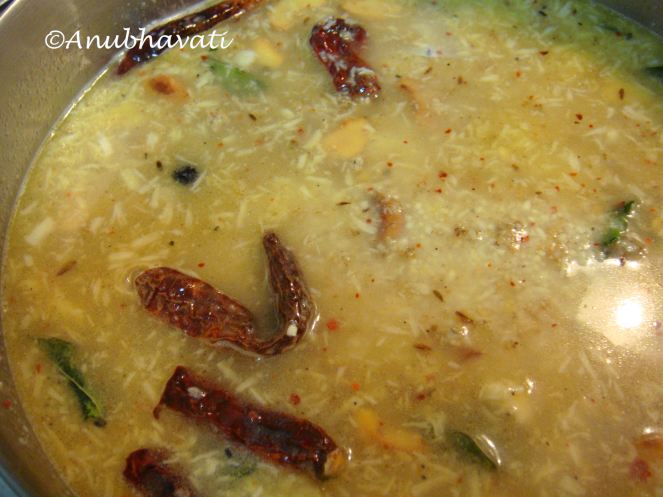
  • Now add the water and mix well. Switch off the heat and transfer to a vessel along with the water.
To be kept in the cooker.
  • Pressure cook it just as you would do with rice.
  • Generally I allow 3 whistles after the weight. Give a couple minutes for the steam to work off and then open the cooker.
  • Hot, cooked Arisi Upma is ready to be served.
  • Serve with Coconut Chutney or Tomato Ginger Gravy.
Naivedhyams/ Festival Offerings.

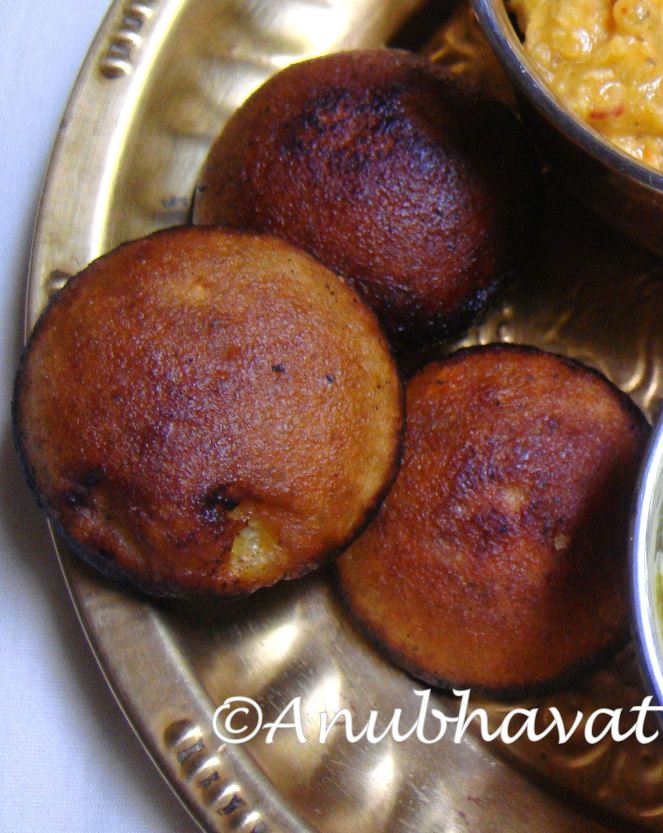
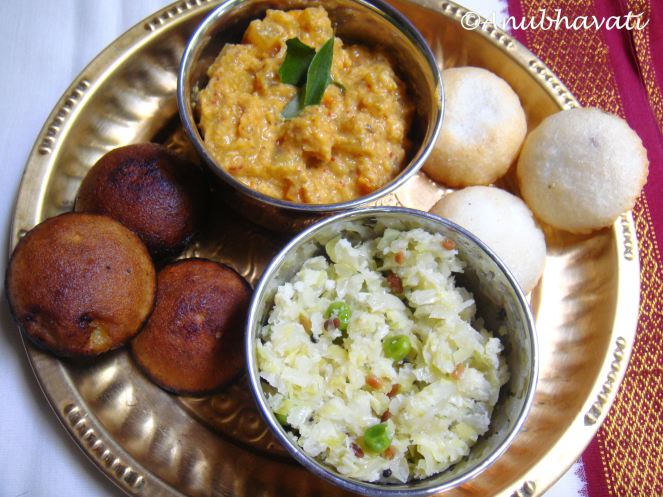
Nei Appam ( Spongy soft balls made from rice and jaggery fried in ghee)

Nei Appam
Nei Appam

Festivals have been an integral part of our lives and they usher in so much of redundant goodness and positive vibrations. Every festival has its own significance and I try to capture as much as I can with what I have lived with, in my childhood. It`s more an effort to showcase to my daughter all the traditions that I had grown up with, although in many cases it can never be the same. It`s always better with a grandmother in the household, leading the way for all of us to learn. I do miss the fact that my daughter is not growing up in a joint family, with elders to guide and grow with….

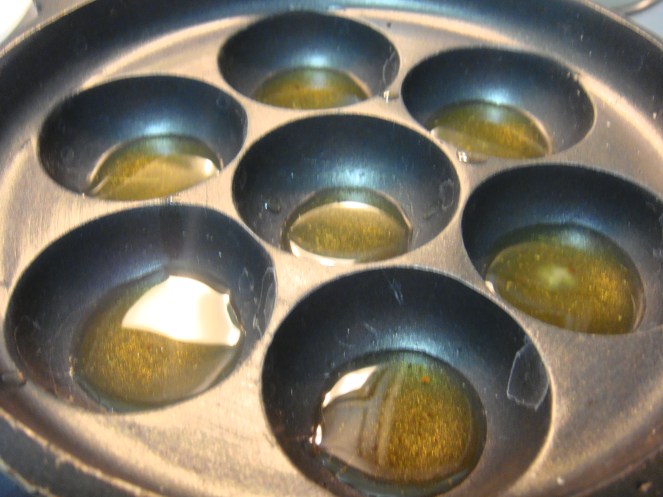
Nei Appam is a staple “neivedhyam” for karthikai deepam, avani avittam, Krishna Jayanthi etc. I remember the lovely heavy bronze Appakaral that Madurai amma had with its huge curvy depressions. I have an Appa Karal thats made of non stick and very shallow depressions. I do miss the heaviness and the beauty of the bronze one I am used to.

INGREDIENTS:

1/2 cup of Rice soaked for 3-4 hours.

A little less than 1/2 cup of Jaggery. (I don`t prefer the dripping with sweetness taste)

1/2 a ripe banana.

1 Tsp Wheat flour.

A pinch of baking soda.

1 tsp cardamom seeds powdered.

1/4 cup of finely chopped coconut pieces.

PREPARATION:


"Appa Karal"


  • Clean the soaked rice and put in to a mixer jar. Pulse it to grind to a smooth paste adding little water .
  • Crush the ripe banana with a fork. Grate the jaggery with a peeler or knife. Set aside.
  • Now add the ripe banana and the grated jaggery and pulse it once again to mix it well. The jaggery pours out more water in to the mixture.
  • It is always better to watch the water added as we dont want the batter too runny.
  • Pour out the batter in to a vessel and add the chopped coconut pieces. Stir well.
  • In the Appa Karal add a few spoons of ghee and allow to heat.
  • Pour out the batter in to the depressions and allow to cook well on one side.
  • Now flip it over with a knife or a skewer  and allow the other side to cook in the ghee.
  • When done, it would look a little crusty on the outside.
  • Remove and allow the ghee to drain on a tissue.
  • Keep closed.
  • The Nei Appam should be a littl crusty  on the outside but soft and spongy on the inside, with the aromas of the cardamom, ripe banana and fried coconut pieces.
  • Offer to the Lord and ENJOY!

HINT:

Retried the recipe today and I added 1 spoon of wheat flour and a pinch of baking soda to the ground batter.The results was an  astonishingly crunchy crust with a very soft spongy inner layer!!!

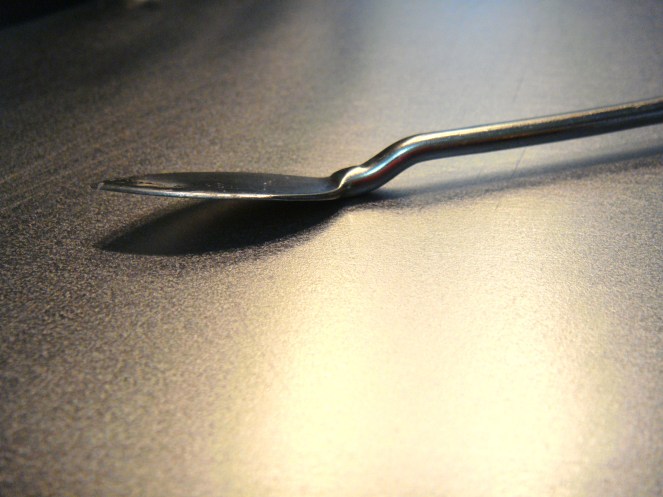
Appam Stick or Flipper!!!
Appam Stick or Skewer.
Festivals & Significance · No Need of Onions!!!

YajurVeda Upakarma (Avani Avittam) – Significance & Purpose.

Avani Avittam Menu
Avani Avittam Menu

Avani Avittam, as I remember, was a day when the men of the family went to the temples, in the morning for performing the Upakarma, in the temples. Upakarma (/upaakarma/) means beginning or “Arambham“, i.e. to begin the study of the Veda (Veda Adhyayanam). For example, Yajur Upakarma means to begin the study of the Yajur Veda. Those belonging to the Yajur Veda observe the Upakarma in the month of Sravana (August-September), on the day of the full moon (paurnami). Why begin study of the Vedas on this particular day? This auspicious day also happens to be the day when Lord Narayana assumed the avatar of Lord Hayagriva. Lord Hayagriva as we all know restored the Vedas to Brahma and also is the God of Knowledge. (Courtesy – Ramanujam.org)

The next question is: why do this every year? In the not too distant a past, Veda Adhyayanam was performed only during the period Avani to Tai (from mid-August to mid-January). Therefore, one is supposed to perform an “utsarjanam” in the month of Tai, i.e., a giving up of the learning of Vedas from Tai to Avani. Just like a Upakarma function there was a Utsarjana function in Tai. The period between January to August was then devoted to learning other branches of our shastras. Thus the cycle of Upakarma and Utsarjana with regard to Vedic studies was established. However, this method took 12 or more years to learn just one veda. Slowly this became impractical and Vedic studies continued throughout the year.

The main purpose of the Upakarma function is to offer prayers and express our gratitude to those rishis who gave us the Vedas — the rishis through whom the Vedic mantras were revealed. These rishis are known as “kaanda rishis”.In the Upakarma Homam as well as in the tarpanam, the offerings are made to the kaanda rishis. In fact this tarpanam is so important that it is included as part of  our daily worship.

On the Avani Avittam day(the full moon day bearing the nakshatra “Avittam” in the tamil month of Avani)  Brahmins after a holy dip ,change the sacred thread and wear a new holy thread. This ritual is known as Upakarma, which means beginning. The sacred thread is referred as ‘Poonool,’ ‘Yajnopavita’ or ‘Janeyu.’

DSC02470

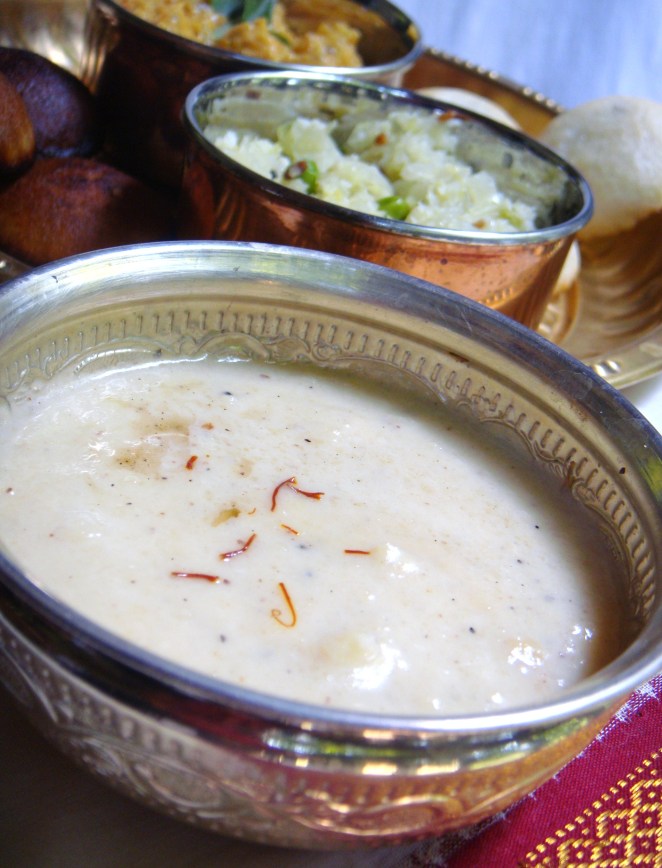
Today`s lunch menu was a little spread, consisting of:

Awards

Kreativ Blogger Award – Thank you friends!!!

An award in the world of blogging comes as a sweet surprise to anyone and so did it when I received it from my sweet fellow bloggers – Lata Raja of Flavours and Tastes from Ghana, and EC of SimpleIndianFood. Thanks a ton Lata and EC…you guys really made my day!!!  In our everyday lives, we do try to be a little different and creative in our cooking , when its a dish for a festival, or a special dinner for hubby dear or even a small evening snack for our kids!!! But well, the awards from fellow bloggers is a whole different thing to me!!!

kreativblogger[1]

The Kreativ Blogger award comes with its own rules!!!

1. You must thank the person who has given you the award.

2. Copy the logo and place it on your blog.

3Link to the person who has nominated you for the award.

4.Name 7 things about yourself that people might find interesting.

5. Nominate 7 other Kreativ Bloggers.

6. Post links to the 7 blogs you nominate.

7. Leave a comment on which of the blogs to let them know they have been nominated.

DSC00172

Here are a few interesting things about myself….Well…as far as I know this is me…

  1. I love anything creative and I yearn to create anything of interest…It could be a simple butterfly from a piece of rag, a new dish from leftovers, little pots of painted terracota, containers from coconut shells etc. I try to find different uses for everyday things!!!
  2. I love watches and I used to be a watch freak buying one every few months whenever I used to feel like it. One one hand, I love the Titan Ragas, the movados, espirit, edge, and even the ones made from fabric….Strange huh?
  3. I love cooking anything and when people I love, enjoy my meal, of what I have cooked for them, I feel so satisfied….I do put in a lot of devotion in my everyday meals with the faith that it tastes much better then ever.
  4. Pictures and photography enthralls me. Angles, lighting, lines of the structure, sharpness, colour depth, detail, everything. I study and drink it in all the details deep.
  5. I collect Ganeshas in all colours, shapes and sizes. When I was in India,I tried offering one lily flower everyday to all my Ganeshas, and found it way too difficult , much to the amusement of my “Pookari”.
  6. Travelling is almost a passion. It could be a small locale very close to home or a place as beautiful as Venice, Egypt, Paris or Greece.
  7. Music is also a passion from when I was a little girl. I crave for good music in any form. I listen to Carnatic Classical, Western Classical, Western Pop, regardless of the language or band.

I nominate the following 7 people for the Kreativ Blogger Award from my end.

Kid Friendly Recipes. · Milk Shakes

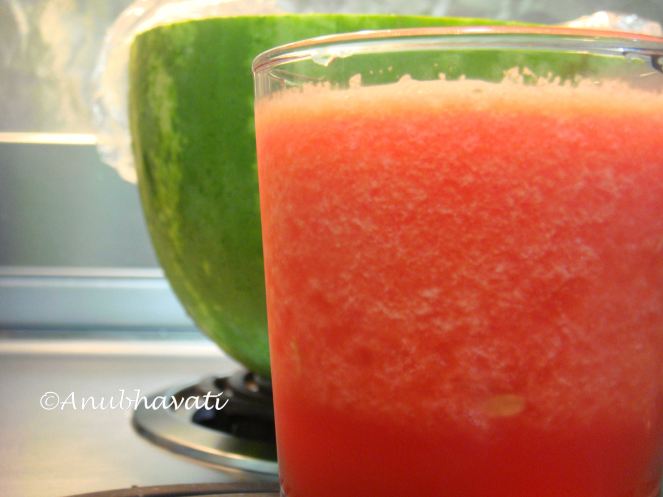
Rose-Minty Watermelon Cooler.

Watermelon Cooler
Watermelon Cooler

It`s that time of the year when your throat is tempted to reach out and grab bottles and bottles of cold water, lemonade, fruit punches or simply any icy milk shakes. One of the most commonly available fruit at this time of the year is the Watermelon. As the name itself suggests, Watermelon is packed with some of the most important anti-oxidants in nature. It`s also a very good source of Vitamin C as well as Vitamin A.Watermelon has an extremely high water content, approximately 92%, giving its flesh a crumbly and subtly crunchy texture and making it a favorite thirst-quenching fruit.

How to Select a Good Fruit:

The best way to choose a flavorful melon is to look at the color and quality of the flesh, which should be a deep color and absent from white streaks. If it features seeds, they should be deep in color.

Many times , however, we do not have this liberty when purchasing watermelon since it is more common to buy a whole, uncut fruit. When choosing a whole watermelon, look for one that is heavy for its size with a rind that is relatively smooth and that is neither overly shiny nor overly dull. In addition, one side of the melon should have an area that is distinct in color from the rest of the rind, displaying a yellowish or creamy tone. This is the underbelly, the place that was resting on the ground during ripening, and if the fruit does not have this marking, it may have been harvested prematurely, which will negatively affect its taste, texture and juiciness. For the most antioxidants, choose fully ripened watermelon and eat it as soon as possible.  (Courtesy – Whole Foods).

INGREDIENTS:

Watermelon chunks roughly chopped.

1/2 spoon of Roohafza.

1 spoon of Edible Rose Water.

A few shavings of grated ginger.

A few sprigs of mint leaves.

1 spoon of Honey.

PREPARATION:

  • Pop all the chunks of watermelon in to the mixer.
  • Add honey, roohafza, edible rose water, ginger gratings and give it a quick whip.
  • Pour in to a chilled glass just before serving.
  • Serve with mint.

Hints:

  • Great, Easy and healthy drink for kids in the evenings after school.
  • Chilling the glasses keeps the drink in it also cooler for a longer time for your guests.
  • Some people do not prefer the aroma and taste of rose. Substitute with ginger and lemon and mint.
Naivedhyams/ Festival Offerings. · No Need of Onions!!! · Snacks & Tiffin Items

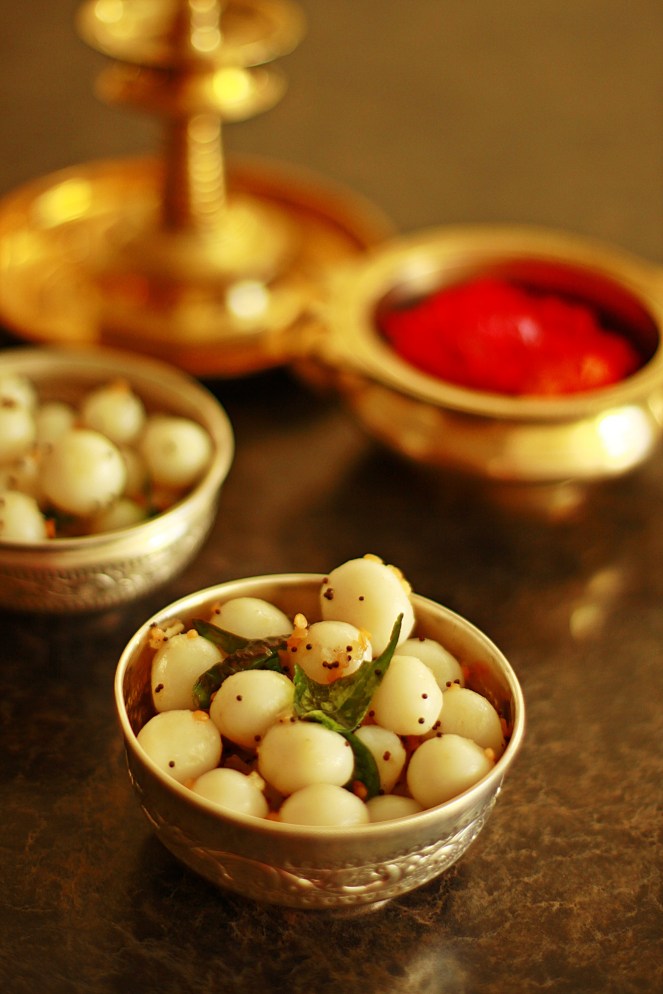
Mini Kozhukattai – Ammini Kozhukattai (Steamed mini rice balls spiced with seasonings).


IMG_4505

Ammini Kozhukattais – I have no clue about the origin of that name and how we came about calling that delicacy that. I know that whenever we set out to make Uppu Kozhukattais and Vella Kozhukattais, we would normally have the outer dough leftover and so amma would always make these mini delicacies!!! In my heart, I am guessing she would purposely have more of the outer dough so we could make this !!! We have this scooped up in a little container, and eat them just like that. Many times I also love to have it as a side for curd rice along with pickle. The preparation is hardly more than 2-3 steps so here goes.

INGREDIENTS:

Kozhukattai Outer Dough.(Please refer my earlier post)

Salt.

2 Green chillies cut in to small pieces.

Curry Leaves,.

Hing.

Mustard.

Broken Urad Dhal.

Oil to season.

PREPARATION:

  • The outer dough of Kozhukattais have negligible salt. So take the dough and add sufficient powder salt and mix it in by kneading well. If you feel the dough is a little dry, add a few drops of coconut oil to your hands.
  • Make a smooth ball.
  • Greasing your hands, shape it in to smaller balls, say, the size of naphthalene balls and keep covered in a bowl.
Balls rolled ready for steaming.
  • Complete the dough by making small balls and arrange on greased idli plates.
  • Steam them in the pressure cooker without weight for 10 minutes on high. As they have already been cooked once, it will cook in steam pretty fast.
  • Once the cooker is switched off, wait for a few minutes and collect all the balls on the serving bowl.
  • In a seasoning kadai, add 2 spoons of oil. When hot, add broken urad dhal, mustard, green chillies, hing and curry leaves.
  • Drop over the kozhukattais and mix well.
  • Delicious Mini/Ammini Kozhakattais are ready to be served.

Serving Suggestions & Hints:

  • It`s a great dish to make along with your kids, as they love to roll the dough in to small balls.
  • Since it does not need a filling, there is no hard and fast rule on the shape.
  • Easy to make with rice flour and hence a very healthy fast preparation.
  • Cooked twice so its healthy for the toddlers as well as for older people.
  • These kozhukattais are best eaten plain all by themselves.
  • Another option is to soak it in steaming hot rasam and serve them as Rasam Balls or with Molagapodi and Gingely Oil.
  • YUM anyway!!!

Sending cups of steaming hot Kozhakattais to Shruthi`s Steamed Treats Event at her blogsite.


Naivedhyams/ Festival Offerings.

Kozhukattai Outer Dough for Preparation of Modhakas.

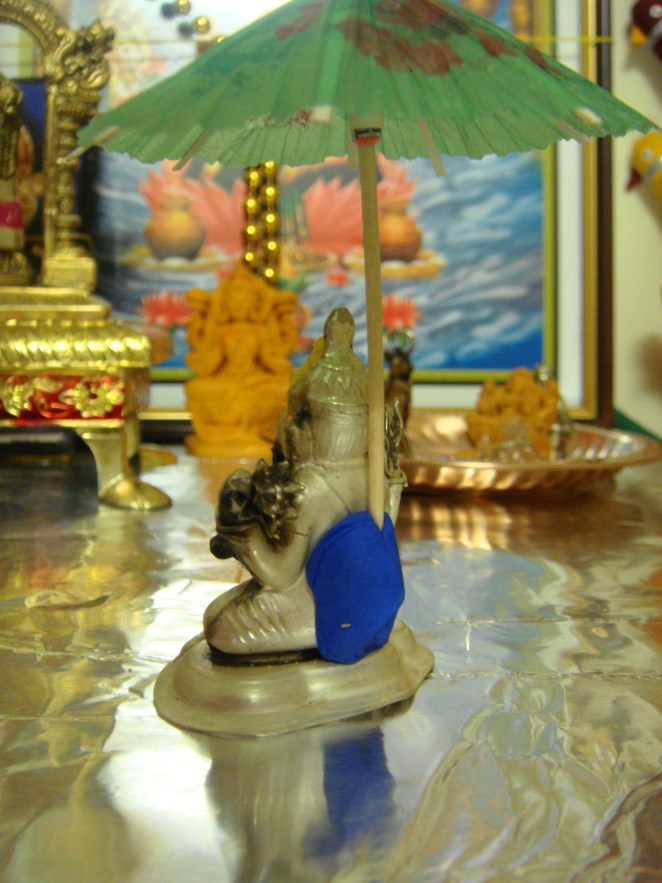
My little Silver Ganesha with a cocktail umbrella.

Every year Vinayaka Chathurthi is celebrated all over the world as the day on which Lord Ganesha, the son of Lord Shiva and Goddess Parvathi bestows his presence on this earth. Vinayaka Chathurthi in my home essentially marks the beginning of good times and of course all other festivals. In Madras, the entire shopping streets are filled with colourful umbrellas and lovely colourful statues of Ganeshas in all sizes and colours. Many people also prefer to buy the plain Ganeshas made of clay and decorate it with flower garlands. Amma and me used to go to PondyBazzar and she would let us choose the idol and the accompanying umbrella to go with it. One time I had a foldable umbrella that I had got during the chathurthi celebrations and refused to part with it for months!!! We would also get as assortment of fruits like wood apple, jamun fruit, apples etc and the signature pooja element which was a lovely green banana leaf, filled with “Arugampullu” and pink flowers. Laden with all this, we would come home excited to set up the mandal for the Lord.

Amma would have already cleaned and decorated the spot with lovely “maakolams“. Maakolam is different from the regular kolams that we use everyday outside out homes. Its simply rice soaked and ground to a fine paste and used to decorate the floors during weddings and festive seasons. The Kolam would be dry and Madurai amma would first place a wooden platform and cover it with silk. She would then gingerly place the Lord on the platform, decorate his neck with little garlands made of flowers and then place a dhoti around him. We would then finally position the colorful umbrella and the stage would be resplendent with his form. The naivedhyam would be Vella KozhakattaisUppu Kozhakattais and of course Ammini Kozhakattais. The fruits would be offered to him and Madurai amma would then start the pooja.

In the evenings, we would some times watch the procession of the Ganesha moving towards the beach. Many times, we would visit the nearby temples and get his blessings. Last year I made my own umbrella for the Lord, using sticks and colorful yarn. I also decorated my little silver Ganesha, in my pooja room with a cocktail umbrella!!!

There are essentially two ways of making the dough…One is by soaking the rice and grinding it, which is pretty elaborate but very tasty, and the other is using rice flour. I shall explain both the procedures below.

KOZHAKATTAI DOUGH BY SOAKING RICE:

1  cup  of raw rice.

A pinch of salt.

Coconut oil.

Water as required.

PREPARATION:

  • Soak the raw rice for 2-3 hours and grind in the mixer or grinder to a smooth batter. It does not matter how much water you use as it gets cooked in it finally.
  • Pour the batter in to a kadai. Make sure that there are no clots and add 1/2 -3/4 spoon of salt and a spoon of coconut oil.
  • Switch on the stove setting it on medium low  and keep stirring to avoid clots.
  • After a few minutes, you will find that the water content is rapidly used up to cook the rice batter, and it slowly thickens.
  • After a few more minutes, it will thicken and be cooked. The signs for that is you will find that when you stir, it comes together as a ball.
  • Also the whiteness of the raw rice will give way to a very slightly off white cooked rice ball.
  • Immediately transfer to a bowl and add a spoon of coconut oil.
  • With your hands, knead the ball inside the bowl by smoothing it and bring it together. This step is very integral as this is what binds the dough and takes away the stickiness.
  • This is a VERY IMPORTANT step and many people fail at this point not doing this. Please use gloves if needed and keep kneading the dough until you feel its a pliable dough that can be shaped easily with no dryness and no cracks.
  • At this point, the dough should be able to  seamlessly shape in to a ball.
  • Set aside in the bowl and cover with a lid.
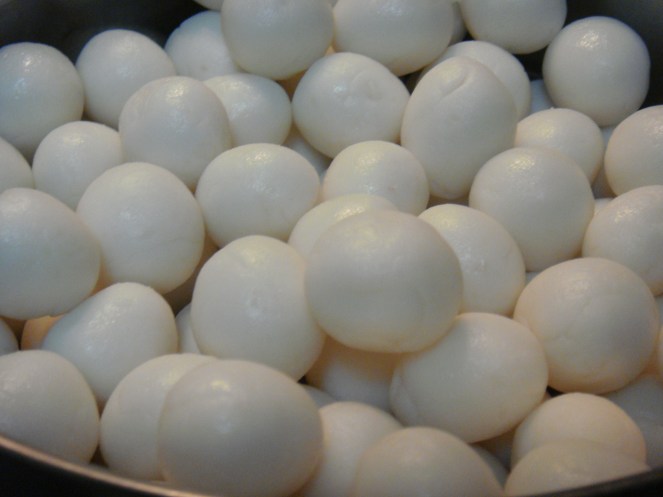
Kozhakattai Outer Dough.

KOZHAKATTAI DOUGH USING RICE FLOUR:

1 cup Rice Flour.

2 cups of water.

A pinch  of salt.

2 -3 Tsp Coconut Oil.

Gloves if required to knead slightly hot/warm dough.

Bowl to knead the dough.

Ktchen Towel/ Damp Paper Towel.

PREPARATION:

  • Please measure all ingredients ahead and keep everything required close at hand.
  • In a kadai, pour the water, add coconut oil and salt and allow to boil.
  • On spotting the first boil, immediately, simmer the stove and add the measured 1 cup of rice flour in to the water.
  • Use a whisk and remove all the clots quickly. This step is very helpful to act quickly so you have no clots.
  • With a spatula, rapidly stir in the mixture as if will thicken using the water to cook the rice.
  • As before, keep stirring until you see that the water is all gone and the entire batter scoops up in your ladle as a single mass.
  • Stir for a few more minutes until you are satisfied and the batter does not stick. This would happen ONLY if the water is not used up so do not fret.
  • Transfer to a bowl, add 1-2 Tsp  of coconut oil and knead well to form a homogeneous ball.
  • This is a VERY IMPORTANT step and many people fail at this point not doing this. Please use gloves if needed and keep kneading the dough until you feel its a pliable dough that can be shaped easily with no dryness and no cracks. Add 1-2 Tsp oil if you require.
  • Keep this dough  covered  with a damp kitchen towel and cover  the bowl with a lid. This is required to keep the dough moist and not dry out.
  • Now you are ready with the outer dough to start making Sweet and Salty Kozhukattais.

Use this smooth outer dough to make delicious Vella Kozhukattai, Uppu Kozhukattai and Ammini Kozhukattais.

Milk Shakes

Coffilicious Cold Coffee – A must for all Coffee Lovers!!!

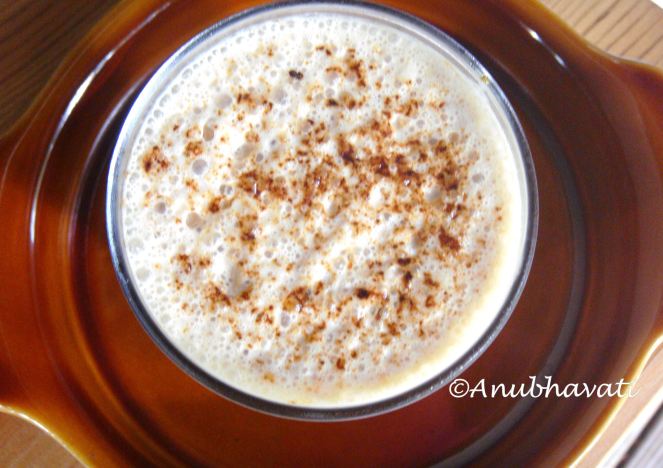
Cold Coffee
Cold Coffee

Coffee – The name itself conjures up the word “comfort”  and all thats nice …Love for coffee has been something that runs in my family. When I was in school, my mom had barred me from having coffee as the staple drink in the morning. When I was into  higher secondary,  I started on having coffee in the mornings. Maduraiamma would  scoop out coffee from the sole coffee canister and press it in to the coffee filter. Thereafter pour piping cups of water and drain out the precocious decoction and collect it in an air tight container vessel which would lock the flavour of the decoction until the next morning. Her coffee was something awesome, the kind that wakes u up and prepares you for the day ahead…. Thick decoction poured in to milk boiled on the stove to perfection with just the right amount of sugar in it. I have never felt the need to add more sugar or to alter the prepared taste of her coffee.

My husband is also a coffee lover and had been wanting to have cold coffee as he was on liquid diet because of teeth extraction. I used to love cold coffee from Geetha Cafe, in T.Nagar. They have a way of making it so deliciously coffeeish with the right amount of ice cream and milk and sugar. They serve in their tall glasses with a lot of cream on top!!!

INGREDIENTS:

3 scoops of Trader Joe`s Coffee  Ice Cream (Vanilla Ice Cream should do too).

1/8 cup of Coffee Decoction from percolator.

1 spoon of Sugar.

1/2 cup of milk.

Low fat Cream for topping. (Optional).

1/3 spoon of Arabica Instant Coffee Powder for topping.(Optional).

Cold Coffee1

PREPARATION:

  • In a blender add the 3 scoops of Ice Cream, Decoction, sugar and half of the milk.
  • Give it a quick pulse and also make sure that the contents of the blender do not splash out.
  • This is the reason we are not adding all the milk upfront.
  • When the contents are well whisked, add the remaining milk and give it a quick pulse.
  • Pour in to a serving glass and top with whipped cream and sprinkle coffee powder.
  • Serve CHILLED.

HINT:

If you are using the plain Vanilla Ice Cream then you would need to increase the Coffee Decoction to be added or in turn, add a spoon of Instant Coffee Powder, to the blender,  for that coffee flavour.

Uncategorized

The First time ever….

Last week was the first time ever that I actually tried my hand (literally) at the art of mehndi decoration!!!!  Henna has been used from the olden days as a natural coolant for the body. It stimulates blood circulation and its also used in the hair for conditioning the scalp and to restore body, bounce and colour. There was a reason why this was a  custom in our country.Mehndi/henna has always been something I loved since when I was a little girl. I remember we had this lovely Henna tree , growing with slender branches in my aunt`s home in Chennai. In the summer, we would patiently pick out all the leaves that were tender and fresh, and the maid would grind it for us, in the stone mill, and collect it in to a little ball and hand it over to Amma. Amma would wait for all of us to have dinner, finish the day`s household chores, ask us to change to dark clothes, so we would`nt stain our dresses with the dye in the henna.

All of us cousins would be extremely excited that it was going to be mehndi night. That meant that we were all going to sleep together in the living room, under the gentle breeze from the fan, stretched out lazily on straw mats. We could chat all night about the whole school year, about our friends, annual day functions, studies, excursions, music lessons, card games,latest books read,  anything and everything under the sun that had been kept untold throught the whole school year. Those were of course the days before the cell phones, e-mails and extreme telecom fixation. Cousins would take time off to write to each other and tell each other about their small and interesting lives…Mums would be happy and encourage the kids….It was a slower life, much more enjoyable, with hardly any time for TV or Nintendo…..And yes, those were the best days of my life….

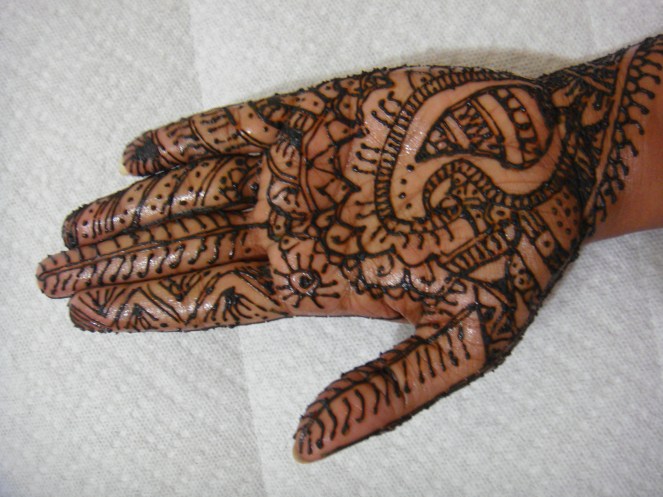
My first Mehndi Application.

DSC02270

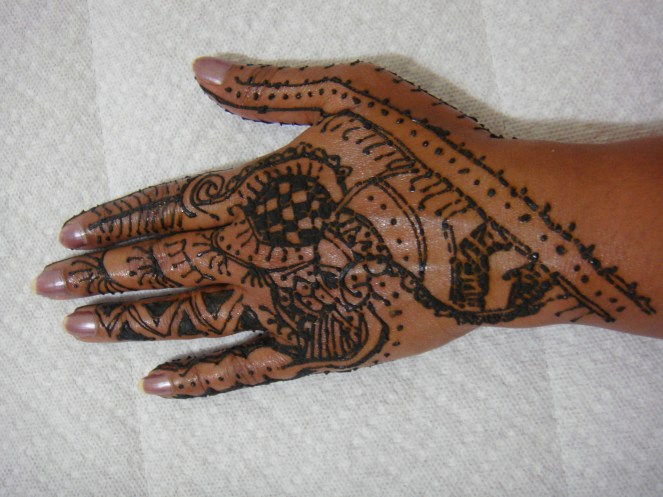
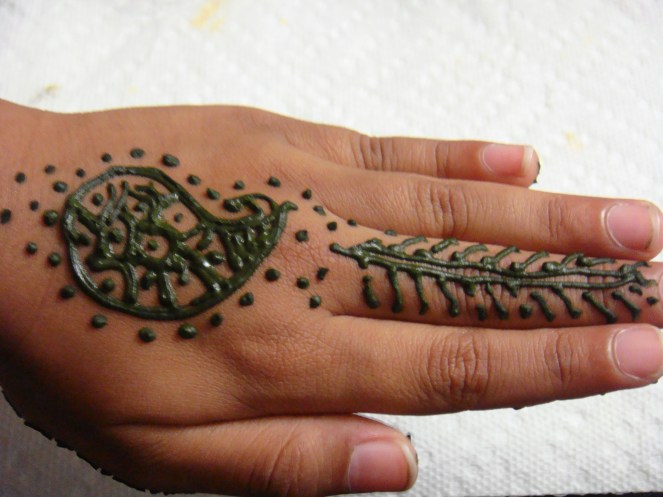
These days as I watch the precision and creativity that has crept in to this beautiful art of mehndi application, there has always been a side of me that wanted to try it out. On my recent Chicago trip, I found a good brand of Mehndi at Patel`s and set about making my own little cone. I spliced a small Ziploc cover(1/2 Gallon) and split it in to two parts.  I rolled it in to a small cone, sealed it with cello tape and filled it with mehndi paste from the bigger cone. After removing all the air I gently sealed the edges with a thin rubber band. Splicing a teeny weeny hole in the end, my mini cone was ready for trial.  I opened my palm and allowed the lines to flow as they wished. With the right consistency of fresh paste and the right size of the aperture, the lines flowed, smooth and easy. It was far easier than holding an awkward store bought cone and trying to be creative. I was happy with the results, at least with my maiden attempt. I also attempted on my daughter S and she loved it!!! It`s more of a longing now, to try and be better, more creative, better lines, better clarity and overall a highly satisfactory feeling. I know I have a long long way to go, but just the smile on my daughter`s face as I tucked her in that night….and  my day was made!!!

My little one`s hand decorated with Mehndi.